Showing posts with label Carey Mulligan. Show all posts

Wednesday, 24 March 2010

Top 10 Steven Moffat moments in Doctor Who


As I'm sure you're aware, the new series of Doctor Who airs in just under two weeks time. While I am not oblivious to the fact that many will be mourning the departure of head honcho Russell T. Davies and, more probably, Doctor David Tennant, this new series has me all excited. A fresh-ish start, a new doctor in the form of Matt Smith, a new companion in Karen Gillan, playing Amy Pond. More importantly, this new series will be running under the stewardship of Steven Moffat, the man behind some of the best episodes of Doctor Who since it's relaunch: The Empty Child, The Doctor Dances, The Girl in The Fireplace, Blink, Silence in the Library, and The Forest of the Dead. Here are our favourite slices of Moffat-y goodness:
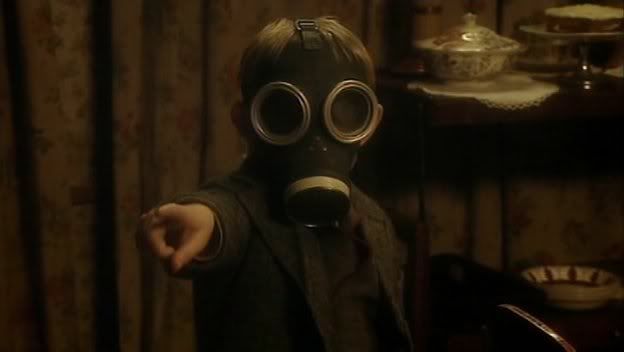

1. "Are you my mummy?"
The Empty Child and The Doctor Dances. The two-parter set in London during the Blitz, as very, very creepy child wearing a gasmask wanders the night looking for its mother. We don't find out what it is until the end of the second part, but we know that it's persistent and dangerous. Did we mention how creepy it is? Moffat also makes great use of Christopher Ecclestone's Doctor, who shows curiosity and bravery while most of us would be running for the door. As an aside, while this list is for Moffat, these episodes remind us what a shame it is that Ecclestone decided to only make one series.

2. The Tardis phone rings
"Don't answer it. It's not for you"
"And how do you know that?"
"Cos I do. And I'm telling you. Don't answer it."
"Well, if you know so much, tell me this. How can it be ringing? It's not even a real phone, it's not connected."
This is a simple little trick, but it works. We know that the Tardis phone can't ring. So how does it feel when it does? Scary.

3. Richard Wilson as Dr. Constantine
Ah, the time honoured tradition of getting a recognisable, respected elderly actor to deliver exposition. As the doctor discovers the abandoned hospital full of corpses wearing gasmasks, Victor Meldrew himself appears, on his last legs, to warn the Doctor. "Don't touch the flesh." The Doctor begins to realise that each patient has the same injuries. "Physical injuries as plague." We also get one of the biggest shocks of the series as the Doctor tries to guess the cause of death. "There wasn't one. They're not dead", Constantine tells him, and knocks over a bin, prompting all of the bodies to sit up. He also gets the first transformation that we see, as he succumbs to the virus.
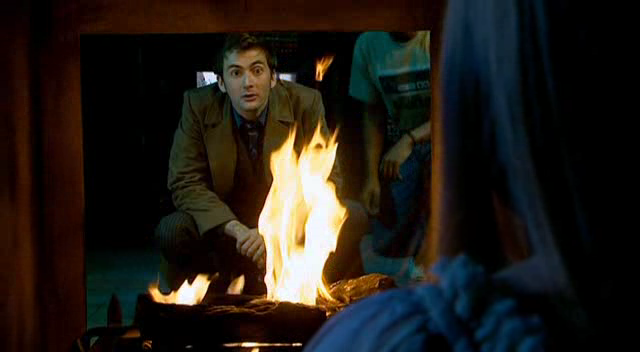

4. What's ticking?
The Girl in the Fireplace sees the Doctor battling robots looking to steal the brain of the Mistress Pompadour. Near the start of the episode, the Doctor finds himself in a young girl's bedroom in 17th Century France. He approaches a clock on the mantlepiece.
"OK that's scary."
"You're scared of a broken clock?"
"Just a bit scared, just a little tiny bit, yeah. Because, you see, if this clock's broken, and it's the only clock in the room, then what's that....Because, you see that's not a clock. You can hear that in the resonance, too big. Six feet, I'd say. Size of a man..."
Also, there are few things more scary than being told by the man who's just founds something under your bed "Don't look round."

5. The Doctor and Madame du Pompadour
While a lot of the complaints about the flirtiness of the Doctor with his companions can be justified, the chemistry David Tennant has with Sophia Myles in this episode is undeniable. It came early enough in the show's run for the "sad, lonely Doctor" schtick to still be fresh, and the rapport between the two actors is great. Probably has something to do with the fact that they were a couple at the time.


6. Pretty much all of Blink
OK, how do I choose a favourite bit of Blink? Can't really. It's scary, it's funny, it's possibly the best thing that Moffat has ever written. Carey Mulligan is fantastic as the plucky Sally Sparrow, the lead in this mostly Doctor-free episode. It's got great, funny supporting characters in DI Billy Shipton ("Life is short and you are hot") and the nerdy Larry Nightingale. The Weeping Angels are brilliant villains. And the gimmick, don't blink or they'll get you, is brilliantly simple and terrifying. Just a great episode


7. Stay out of the shadows
Like Blink, Silence in the Library has a simple premise: There's something in the shadows that kills people.
"Almost every species in the universe has an irrational fear of the dark, but they're wrong, because it's not irrational. It's Vashta Nerada"
"What's Vashta Nerada?"
"It's what's in the dark. It's what's always in the dark."
Moffat continues his run of things that scare children, as remind us that we used to be scared of them too: Losing our mother, realising that something's under the bed, and finally: There's something in the dark. It's also, like Blink and The Girl in the Fireplace, got a neat one-liner that sums up the threat. "Don't blink" for Blink, "What's that ticking?" for Fireplace, and "Count the shadows." for Library. Because, as the astronaut archeologists find out, if you get two shadows, you're done for. "Who turned out the lights?"
8. Miss Evangelista
The secretary to Steve Pemberton's pompous archeologist, Miss Evangelista is well-intentioned but very, very stupid. "My dad said I had the IQ of plankton, and I was pleased." All the crew laugh at her, and we do as well. Which makes it a bit of a shock when she dies first. The crew have to listen as she "ghosts" (her consciousness is briefly trapped in her intercom after her death), and tells them that she can't see. She asks for Donna ("The nice woman") and tells her "What I said before. About being stupid. Don't tell the others, they'll only laugh." Moffat's not just about scares, this scene is impressively touching. Of course, Miss Evangelista comes back in part 2, with her beauty and brains swapped.

9. A brief message from the head librarian
The creepy help points with, as Donna points out, a real face, helpfully sets up the episode for The Doctor and Donna in a wonderfully creepy monotone. "There follows a brief message from the head librarian for your urgent attention. It has been edited for tone and content by Thelman Lux automated decency filter. Message follows: Run. For God's sake, run. Nowhere is safe. The library has sealed itself. We can't. Oh. They're here. Arg. Slarg. Snick. Message ends. Please switch off your mobile comm units for the comfort of other readers."
It's a tried and tested trick, the old discovery of a warning that ends with the messenger's death, but there's a reason it's here. Because it's effective.

10. Doctor Moon spills the beans
For most of Silence in the Library, we're trying to understand the connection between the Doctor and Donna's adventures in the library, and the little girl who seems to be undergoing pyschiatric treatment, who is being told that the library is just in her mind. Near the end of part one, the little girl is told that her doctor would like a word. As she sits and her father leaves the room, Doctor Moon tells her:
"This is important. There's the real world, and the world of nightmares. That's right, isn't it, you understand that?"
"Yes I know, Doctor Moon."
"What I want you to remember is this, and I know it's hard. The real world is a lie. And your nightmares are real. The library is real. There are people trapped in there. People who need to be saved. The shadows are moving again. Those people are depending on you. Only you can save them. Only you."

I know I've missed out several things here, including Alex Kingston's fantastic River Song, and strangely it seems to be heavily weighted towards Silence in the Library, but hopefully this has been a nice reminder of why we should all be very excited about the new series of Doctor Who. Personally, I can't wait.

Thursday, 26 November 2009

Ramblings and Retrospectives: Another Top 5 Openings

Well, Ben suggested I give my top 5 openings in order to try and generate some interesting discussion. It did get me thinking. What makes a great opening? For my money, a great opening should set the tone for what's going to follow. If you make the opening the best thing about the film/record, what follows is going to be a let-down. The opening should grab our attention and let us know what we're in for. With that in mind, here are my Top 5 Openings.
I should also warn you that I'll change my mind about these as soon as I publish this post. So be prepared for a few openings more in the near future

1. Snot Boogie, The Wire

David Simon and Ed Burns' masterpiece has too many memorable scenes to include on this list, but this opening scene is a classic. It introduces us to our "hero" Jimmy McNulty (the fantastic Dominic West), and shows us the pointlesness and tragedy of gun violence. It also balances tragedy with a dark sense of humour, one of the key traits of the show.

2. As I Sat Sadly By Her Side, Nick Cave and the Bad Seeds, No More Shall We Part (2001)

Choosing a favourite Nick Cave opener was a tricky one. After all, we've got The Mercy Seat, Dig Lazarus Dig, and Papa Won't Leave You Henry (the latter nearly beat the song I chose). But for my money, As I Sat Sadly sets the tone perfectly for the Nick's melancholy masterpiece. The Mercy Seat is clearly the stand-out of the album Tender Prey, the only song that comes close to matching it is Deanna. On another day I would have chosen Papa Won't Leave You, but there we go. On this Thursday afternoon I'm going for melancholia over fury!

3. Blink, Doctor Who (2007)

Blink regularly features in lists of the best Doctor Who episodes, and with good reason. Namely, that it's damn scary. The weeping angel statues and Stephen Moffat's ingeniuous (although plot hole-ridden) script create a taught, nerve-racking episodes. This opening shows Carey Mulligan's plucky Sally Sparrow uncovering a message written on the wall of an abandoned house telling her to duck. Seriously duck. Why the hell doesn't she duck!

4. Halloween, dir. John Carpenter (1978)

Yes indeed, the granddaddy of all slasher films also has the best opening sequence. John Carpenter's creepy synth music and the wonderful first person viewpoint lead to one of the most surprising revelations of the film. The opening perfectly sets up Michael Myers as the boogeyman himself, even without the aid of Donald Pleasance's Sam Loomis. And there's almost no blood.

5. The State I Am In, Belle and Sebastian, Tigermilk (1996)

I'm more than willing to admit that my Belle and Sebastian fixation is a little unhealthy, but the fact is that they're one of my top five bands. Yep. There it is. Anyway, this first track on their first album sets out their stall: it's sad, funny, and dream-like, matching lyrics like "So I gave myself to God/There was a pregnant pause before he said OK", and "I kicked the crutches from my crippled friend". Back when Stuart Murdoch still wrote all the songs, before Stuart David went off to Looper and his novels, and Isobel Campbell went solo, Tigermilk is arguably their best album, with an emotional honesty ("Oh love of mine/would you condescend to help me/cause I'm stupid and blind") that was sorely lacking from their last album The Life Pursuit. I should also mention that I came very close to replacing this track with The Stars of Track and Field from their equally superb second album If You're Feeling Sinister. Maybe next time.

Wednesday, 25 November 2009

Recent Release Reviewed!!!! An Education


An Education


Director: Lone Scherfig
Screenplay: Nick Hornby
Based on the memoir by Lynn Barber


We complain a lot about the state of British cinema. And the state of British television, but that's for another time. Let's face it, we do have a lot to moan about. One of the most frequent complaints is our apparent addiction to that fluffiest of sub-genres: The period costume drama. Now, it's arguable that An Education is very much in that vein. It's certainly drama, the actors are wearing period clothing, drive around in vintage cars, and yes, it's definitely set in the early sixties. Oh, and it stars such seasoned veterans as Emma Thompson, Olivia Williams, and Alfred Molina.


But the whole enterprise has a wonderful sense of energy and vigour to it. This is in no small part due to the performance from Carey Mulligan in the lead role of Jenny. Jenny is in her final year at school, studying hard for her Oxford exams under pressure from her parents Jack (Molina) and Marjorie (Cara Seymour). One day she meets David (Peter Sarsgaard), a suave older man who gives her a lift. David quickly introduces her into a world of wealth and, perhaps most importantly, fun. Before long Jenny is going to Oxford, and even Paris. Her parents are far from unsusceptible to David's charms, and are easily won over by his charisma and apparent connections. But even as things seem to be going perfectly, Jenny slowly realises that David may not be quite who he says he is. Soon she has to choose between a chance at Oxford, and the glittering world David may be able to provide.


I must admit that, no matter what Carey Mulligan does, I will always see her as Sally Sparrow from the fantastic episode of Doctor Who, Blink. She was fantastic there and she's fantastic here, giving Jenny the right mix of innocence and intuition that allows her to look beyond the less pleasant realities of David's way of life in order to keep exploring the world he offers. Jenny does occasionally run the risk of becoming unlikeable; she's a little pretentious, but also genuinely insightful. But we keep rooting for her largely because of Mulligan's wonderful performance, and because, to paraphrase a Kramer quote from Seinfeld, her "unbridled enthusiasm".


Coming back to that period costumed drama theme, one big difference is the casting of Peter Sarsgaard as David. The actor is undoubtedly talented, and while it seems a little strange to cast an American as the male lead, he works. His accent wanders a little, but for the most part he's excellent; narcissistic, smooth, but also desperately insecure. He also plays well off Dominic Cooper (who would have been pehaps a more obvious choice for David, given his looks) and Rosamund Pike, who play his companions. Cooper shows some range as the David's "business partner" Danny, who's more frank about their work. Pike is especially hilarious as the dimwitted but affable Helen, who pleads with Jenny not to go to Oxford because she'll become "spotty and speccy". She also gets to wear some wonderfully garish costumes, contrasting with the grey and brown that permeates the world that Jenny's become used to. In Scherfig's film, Twickenham is a grey, rainy dead end. Jenny dreams of Oxford and Paris, and, accordingly, the director shoots the two cities as sunny, dreamy heavens.


A review of An Education wouldn't be complete without a few gushing sentences praising Alfred Molina's performance. The scenes that he shares with Mulligan the underrated Cara Seymour are wonderfully written and performed. We are quickly convinced that the last push towards Oxford is what Jack has been waiting for since Jenny was born, and the pressure he puts her under comes entirely from love. But he's also more than willing to accept David as his daughter's suitor, as he believes he can take care of her financially. He's as excited as Jenny by the dashing David, with his expensive cars, Goonies impressions, and connections. Cara Seymour is superb as Jenny's more permissive mother, who is both pleased with her daughter and terribly melancholy thanks the lifestyle she and Jack have to lead in order to support her. Olivia Williams is also excellent, investing the "stern teacher with a heart of gold" with depth and a not a little sadness.


Scherfig shows a surprising sense of what life was like in London at the time for a Danish director, aided by Hornby's canny script. If one thing works against An Education, it's that it's all a little predictable. But this was never going to be a film with twists and turns. From the moment David shows up in his flash car, firing chat-up lines, we know he's sure to turn out to be a bad 'un. I must also mention that I thought the scenes with Emma Thompson's matter-of-fact headmistress were a misstep. A lot of what works about the film comes from the nimble, clever script. But when Jenny has her two confrontations with the teacher, subtlety is set aside in favour of "telling the audience was the film is about". But when a film is as enjoyable, and well-shot and performed as this, predictability and a couple of scenes that don't really work aren't really too big an issue.

7.5/10