The House of the Devil Starring: Jocelin Donahue, Tom Noonan, Mary Woronov, Greta Gerwig Written and directed by: Ti West
"Are you not the babysitter?"
1980s. A title card explains that during the 1980s over 70% of Americans believed in the existence of abusive Satanic cults. College student Samatha (Donahue) needs cash, fast. She's just found her dream apartment, but has to raise the deposit before the weekend. Desperate, she finds a flyer advertising a babysitting job for Mr. Ullman (Noonan). Mr. Ullman sounds creepy on the phone, but he's willing to pay her well for a single night's work. When she and her friend Megan go up to their huge house in the middle of nowhere, Ullman reveals that he wasn't entirely truthful. Megan thinks they should leave, but Samantha decides to take the job anyway...
The House of the Devil is a love-letter to films from the 1970s and 1980s. From the poster to the soundtrack, from the "based on true unexplained events" premise to the clothes and colour palette, everything is beautifully reminiscent of a past era of horror film-making. It's also really rather good. The last time a film was promoted in a similar fashion we got the underwhelming Grindhouse, with it's great trailers and posters but disappointing substance (although I do like Planet Terror). The House of the Devil is a different animal. For those expecting an exploitation film due to the poster and the tagline, that's part of the joke. Spooky films like Halloween and Rosemary's Baby seem to be the touchstones here. A big clue with regards to tone should be the presence of Larry Fessenden as producer, who wrote and directed low-key horror films Wendigo and The Last Winter.
Ti West has become the next big horror director thanks to this film, and based on the evidence presented here, it's a deserved title. His first film, The Roost, wasn't great but was well-intentioned and boasted a great Tom Noonan cameo, and from all accounts Cabin Fever 2 is awful, but West has disowned it as a product of studio meddling. Here, he shows a very impressive handling of pace and tension, as well as proving adept at building menace.
Jocelin Donahue is a great discovery as Samantha. Apart from looking the part, she carries the film with a believable performance as her growing apprehension leads to terror. Mary Woronov is appropriately creepy as Mrs. Ullman, who makes odd references to the Ullman family history, and Greta Gerwig (who's been getting raves for Greenberg) makes for a excellently sarky and funny best friend. There's also a nice cameo from Dee Wallace (formerly Dee Wallace Stone) as "The Landlady".
The real star of the film, however, is Tom Noonan as Mr. Ullman. It's hard to think of another actor who can make creepy so sympathetic. With another actor, Mr. Ullman's dialogue would become typical "horror movie villain" dialogue. But with Noonan, there's always the possibility in the back of the viewer's mind that Ullman is geniuinely well-intentioned but keeps making a bad choice of words. "Oh, thank goodness. You're saving me. And I promise to make this as painless for you as possible." Of course, at the front of our minds is the thought that Ullman is up to no good. But his soft voice is so wonderfully at odds with his imposing height, dark suit and cane.
The House of the Devil goes at it's own pace. No suspicions are confirmed or dispelled until quite late into the film. We keep waiting for something to happen, which makes the sudden bursts of action really very shocking. An impatient viewer would call the film boring, but if you let yourself be immersed in the story and the atmosphere, The House of the Devil is one of the most rewarding horror films I've seen in a long time. And it is all about the atmosphere. This should appeal to horror fans, as well as those not usually drawn to the genre. It's a slow build rather than a gory blood-fest. And Tom Noonan is just excellent.
The troubled and turbulent production history of The Wolfman remake has received a lot of press. From the replacement of original director Mark Romanek (One Hour Photo), to rewrites and reshoots, perhaps the most striking part of all of this is how committed Benicio Del Toro has stayed to the film. One of the producers on the film, he has stuck with it throughout and remained enthusiastic about the endeavour. Despite all of the negative word of mouth the film got prior to its release, I was really hoping that, at the least, The Wolfman would be fun.
Renowned stage actor Lawrence Talbot (Del Toro) gets word that his brother Ben has gone missing. He returns home after a long absence to the family home only to be told by his eccentric recluse father John (Hopkins) that Ben's body has been found, horribly mutilated. Lawrence promises his Ben's fiancée, Gwen Conliffe (Blunt) to find what killed his brother and heads for the local gypsy camp. Gypsy Maleva (Geraldine Chaplin) tells him his brother was cursed. The camp is attacked, and Lawrence is bitten while protecting a gypsy boy. He recovers much faster than expected, arousing the suspicion of Detective Frederick Abberline (Weaving), and begins to have strange dreams...
This review is going to echo what a lot of other reviews have said. The Wolfman is very patchy. The influence of different creative forces are clearly visible, and they rarely mesh well. There's subdued drama, courtesy of Lawrence and Gwen's tentative romance, hammy villainy, thanks to Hopkins entertainingly sinister performance, gory creature feature, and Gothic horror. The parts are entertaining but the whole is a bit of a mess. Quiet courtship and father-son tensions sit uneasily beside spilled intestines and an overwrought but entertaining sequence in a London madhouse.
The force keeping all these disparate parts together is Del Toro's performance as Lawrence Talbot. Resisiting the temptation to go over the top, his careful, low-key performance serves as an excellent base for the film to work from. Blunt also does good work in an almost thankless role as Gwen, when she is given more to do than quiet and concerned. Hopkins, as the trailer made clear, is channeling Malcolm McDowell for the mad-as-a-chicken-with-lips patriarch, which actually leads to one of his better performances in recent years. He handles the cheesier dialogue with a wicked grin, and only really goes over the top towards the end. Weaving gets the balance right as Abberline, doing stoic and sceptical without sacrificing the sense of fun. Geraldine Chaplin gets a nice little part as Maleva, while Anthony Sher goes over the top as the asylum head whose arrogance gives us a clear idea of his fate.
Johnston does surprisngly good work with the visual aspects of the film. Blackmoor is a foggy, threatening place that recalls the original film, while the London scenes are filled with pleasantly street-lit murky streets. The Talbot family home is magnificently grand and Gothic, but we see too little of the inside. What we do see is well-designed. It's filled with cobwebs and stuffed animal heads, remnants of Sir John's travels. The brief glimpses of the asylum also benefit from the production team's eye for detail. The action sequences are exciting enough, and though the gorier scenes are a little jarring, they are well-handled.
Where things really go wrong is during the transition from the second act to the third act. It's been reported that the DVD will feature an extra 20 minutes, and they are a twenty minutes that the narrative, at least, could really benefit from. Things are far too rushed during the build-up to the finale, which is also a disappointment. The transformations are decent but not spectacular, a shame given the involvement of effects maestro Rick Baker. The wolfman himself is faithful to the original, which is fun for fans but perhaps not very impressive for those who are less familiar with it.
But I would like to applaud the filmmakers for their good intentions. Certainly, The Wolfman is far from perfect, but the decision to remain surprisingly faithful to the original film, setting the narrative in the late 19th Century, the wolfman make-up, are all signs that the idea is solid. When The Wolfman works, it's wonderfully entertaining, and parts of the film are exactly what I want from this sort of film. Sadly, the filmmakers are unable to keep the momentum going.
So, what to make of it? Entertaining, yes, but also disappointing. The parts are good, the whole does not work as well as it should. It has good performances and solid action sequences, not to mention a wonderful atmosphere. It's also very uneven and suffers from a weak ending.
This is sort of a preface to a review of The Wolf Man. The werewolf film is a bit like the vampire film's weird brother. Emotionally complicated, difficult, but often surprisingly interesting and entertaining. I've always had a soft spot for the lycanthropes, so here, in no particular order, are my favourite werewolf films:
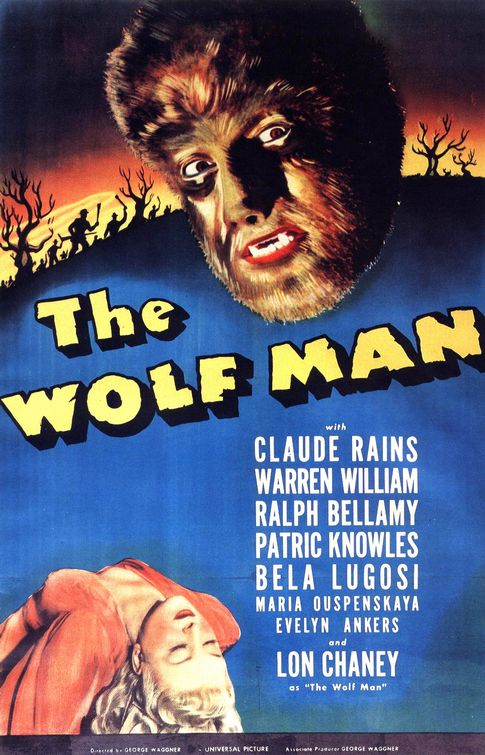
1. The Wolf Man (1941) Dir. George Waggner The classic Universal film is a pleasure to watch, as Lon Chaney Jr. returns home after the death of his brother, only to be attacked by a savage beast. The transformation is of course dated but remains pretty impressive, and the film itself is excellent, with a wonderful atmosphere and great performances from Chaney and Claude Rains as his father. Bela Lugosi also has a small role as a werewolf gypsy. It might not reach the heights of Bride of Frankenstein, but this is a superb Universal Monster Movie.
2. The Company of Wolves (1984) Dir. Neil Jordan This adaptation of Angela Carter's stories is an odd, dreamlike fairytale brimming with menace and sexuality. Young Rosaleen is advised by her Grandmother (Angela Lansbury) to be wary of young men whose eyebrows join in the middle, telling her stories of dark, brooding men with secrets. Before long, Rosaleen is out walking in the woods wearing a red riding hood....It's visually gorgeous, and still boasts one of the most striking transformations with Stephen Rea revealling the wolf within. The cast also includes David Warner, Brian Glover, and Terrence Stamp.
3. Ginger Snaps (2000) Dir. John Fawcett Ginger Snaps took the "That time of the month" joke inherent in werewolf movies and turned it into a darkly funny, gory, creepy and actually rather affecting little film. Sisters Ginger (Katherine Isabelle) and Brigitte (Emily Perkins) are the self-styled outcasts of their high school. One night Ginger is attacked by a monster, and starts to change. Brigitte has to step out of the shadow of her big sister and take responsibility, and action. It's geniunely clever and funny, and we care about the characters. Think of it like a good Jennifer's Body. It also spawned a surprisingly good sequel, and, bizarrely, a prequel set in the 19th century.
4. Dog Soldiers (2002) Dir. Neil Marshall Marshall's debut film is about a group of squaddies who are caught in the Scottish highlands by a group of werewolves. Far better than it has any right to be, the action is well handled, it's well-cast (Kevin McKidd, Sean Pertwee and Liam Cunningham star), and it's very, very funny. It does occasionally suffer from it's low budget, but anyone looking for a entertaining action movie with a twist won't be disappointed.
5. An American Werewolf in London (1981) Dir. John Landis I've already waxed lyrical about this film before on this blog, but it really is excellent. David (David Naughton) and Jack (Griffin Dunne) are hitchhiking around England when they are attacked on the Yorkshire moors. Jack is killed, but David survives, and we all know what happens next. It's Landis' best work: Funny, scary, and surprisingly dark. It also has Rick Baker's creature transformation, that excellent pub scene (Brian Glover again) and Jenny Agutter going for it. It's probably the best film on this list.
6. The Howling (1981) Dir. Joe Dante Made at the same time as Landis' film, The Howling always suffers in comparison to the superior film. However, it's a lot of fun nevertheless. After a traumatic encounter with a killer, reporter Karen White (Dee Wallace Stone) and her husband go to an exclusive retreat run by Dr. George Waggner (Patrick Macnee). However, there's more lurking in the woods than rabbits. Filled with pop culture references, it never quite gels as a whole but there are a lot of excellent sequences. The transformation doesn't match up to Rick Baker's creation, but it's good. Oh, and it has Dick Miller.
7. Brotherhood of the Wolf (2001) Dir. Christophe Gans Gans' film is a big hodgepodge of wildly different ingredients. It's a werewolf movie, a lush period costume drama, and a martial arts film. It's also very entertaining. It does occasionally threaten to lose the plot completely, but it's always great to look at. It also has good performances from Vincent Cassel, Monica Bellucci, Samuel le Bihan and Marc Dacascos. When it works, it's great. When it doesn't, it's the best kind of big mess.
8. Wolfen (1981) Dir. Michael Wadleigh A werewolf film from the director of Woodstock? Well, it's actually pretty good. A mulleted (and apparently very drunk) Albert Finney plays New York detective Dewey Wilson, who is investigating the brutal murder of two yuppies. There's some interesting exploration of Native American mythology, some decent shocks, and solid supporting work from Tom Noonan (as a creepy wolf expert), Edward James Olmos (as the Native American prime suspect) and Gregory Hines (as Dewey's tech friend). It's a little slow-going, but the "wolf-vision" is well designed, and it's got a good ending. Oh, and Tom Waits cameos!
Pontypool Starring: Stephen McHattie, Lisa Houle, Georgina Reilly Written by: Tony Burgess, based on his novel Director: Bruce McDonald
"Sydney Briar is alive. Sydney Briar is alive. Sydney Briar is alive"
If you think we've seen too many vampire films recently, cast your mind back to a few years ago and remember the glut of zombie movies. After the success of 28 Days Later, Shaun of the Dead, and the Dawn of the Dead remake, multiplexes were flooded with different takes on the subgenre. After a while things seemed to die down and occasionally we'd get a really good zombie movie, like Rec. We're at a level now where the word "zombie" won't provoke a sigh of boredom, and it's nice to have that back again!
So, Pontypool is a 2008 film from Canada, that director Bruce McDonald would prefer we wouldn't call a zombie movie. Sorry, Bruce, but it is the easiest way to describe the film without resorting to a made-up word. It's only got one recognisable face in Watchmen star Stephen McHattie (he played the first Nite Owl), it's low budget and it takes place almost entirely in one location. And it works. Shock-jock Grant Mazzy (McHattie) has fallen from grace. He's now working for the local radio station in Pontypool, that operates out of the town's church basement. The show's producer Sydney (Lisa Houle) is getting tired of his attempts to make the local news inflammatory, while the young assistant, Laurel-Ann (Georgina Reilly), is a little smitten with him, sneaking scotch for his coffee. Then the "Sunshine chopper", which is in fact a man sitting in his car on top of a hill, reports that people have started attacking each other. Before long the whole town has gone mad, and the three must find out how to avoid being infected with the strange virus.
Bruce McDonald has stated that Orson Welles' War of the Worlds broadcast was the touchstone for this film, and what a fine touchstone to have. It's always nice to see character actors take on a leading part, and McHattie is superb. An irreverent hero in the finest 70s tradition, it's largely his performance that keeps us so involved, as Mazzy goes from wry sarcasm to geniune terror. Houle is also good as the single mum producer, and Reilly is effective, although given less to work with.
The idea of Pontypool's virus is an interesting one. Essentially, certain words have somehow become infected. The easier they are to understand, the quicker they are poisoned. At around the 20 minute mark, a French language announcement hijacks the radio station's signal. Mazzy and Sydney translate it, reading it out as they go. As Mazzy speaks, they get to the troubling end of the message: "Do not translate this message". The key to surviving, it seems, is to not speak English.
Technically speaking, the infected in Pontypool aren't zombies. They aren't undead, they are just brainless, focusing in on people's speech. However, the familiar tropes of the zombie film are present and correct. The infected vomit blood, they besiege the church in which Mazzy and his team have barricaded themselves. And there's the familiar social commentary. The army arrive, shooting people indescriminately, and they soon become as much of a danger to our heroes as the infected.
Unfortunately, the film is so enamoured of its premise that some tension is lost in the final third as the plot is explained over and over again. While the idea is complicated, it doesn't require quite the amount of exposition that the film gives it. The horror takes a back seat as Mazzy and Sydney discuss how to avoid infection. It's interesting, but not quite as gripping as the first two acts. Overall, Pontypool is an intelligent, exciting entry in an overcrowded subgenre, and is well worth seeking out. McHattie is superb, and I look forward to the sequel, already in production, Pontypool Changes. Apparently, if the second is a success, a third film is written, Pontypool changes everything. It's also well worth sticking around for the end credits, as a nice little coda rounds things off in great style.
Antichrist Starring: Charlotte Gainsbourg, Willem Dafoe Written and directed by: Lars von Trier
"A crying woman is a scheming woman"
Don't watch this if you're squeamish, or if graphic gore and/or nudity upsets you. There, that's done.
Antichrist certainly kicked up a lot of controversy when it was released at Cannes. Critics were subjected to a film that was not only deeply unsettling, but apparently misogynistic and featuring graphic scenes of genital mutilation. When one particularly self-righteous journalist from The Daily Mail demanded that von Trier justify himself, von Trier told him that he didn't have to. He told the assembled critics that they were his guests, and that he was the greatest filmmaker alive.
What is most surprising to me is that any of the Cannes critics were surprised that they were offended. When a filmmaker as controversial as Lars von Trier says that he's made what he called a pornographic horror film, anyone who has heard of even one of his films braces themselves. This is the man whose most mainstream films are Breaking the Waves, Dancer in the Dark, and Dogville, three incredibly emotionally bruising works. And he says he's made a horror film? I saw Antichrist expecting to be shocked and upset, and I was not disappointed in that regard.
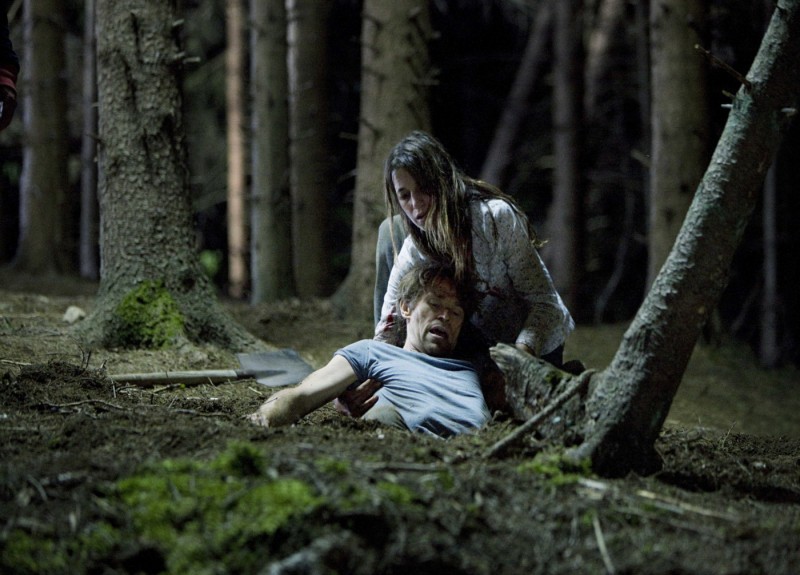
The film starts with a strikingly shot black-and-white slow-motion sex scene between He and She. As they make love, their young son gets out of his cot and falls through the open kitchen window to the street below. Hysterical with grief, She is hospitalised and medicated. He, a therapist, is convinced that he knows what is best for her and decides that she needs to face her darkest fears. He establishes that she is most afraid of Eden, the forest where they own a cabin. The two of them trek up there, as He makes her confront the things that she is afraid of. However, all is not right at Eden. He begins to realise that he has made a terrible mistake, and that She is not getting better.
First things first, Antichrist unsettled me deeply. It's horrifying, troubling and upsetting. There's been some lively critical debate as to whether the whole thing is just a big joke, with Mark Kermode in particular believing that von Trier is giggling behind each frame. Well, that may be the case. It's always difficult to gauge what he's up to, but I found the film to be an almost entirely successful horror film. It's adult, it takes its time, and I can't think of many films that present such horrific situations without a single note of humour. That said, there are moments where it's almost a little to ridiculous. Shortly after arriving, Dafoe sees a deer with a miscarriage hanging from its haunches. Disgusting and unnerving yes, but that's got nothing on the fox gnawing at its own entrails that looks up and tells Dafoe that "Chaos reigns". It's ridiculous, but the atmosphere is so overpowering, and the performances so committed that, for me at least, Antichrist is very much a po-faced horror.
Speaking of the performances, they are utterly fantastic. Dafoe has the less showy part. He makes his character complex enough so we're not quite sure if we're rooting for him early on. He is so convinced that he's right that he does seem to be risking Her mental and physical health early on when he decides to take Her off her medication. The slightly smug condescension soon turns to horror as he realises what's going on with Her.
Charlotte Gainsbourg is stunning as She. Gainsbourg has played both unsympathetic (21 Grams) and sympathetic (I'm Not There) before, but I've never seen her give such a powerfully raw performance. Her grief is incredibly physical in the first part of the film. Both Dafoe and Gainsbourg give brave performances, but hers is tremendously so. The levels of nudity and violence are such, and they're often combined, that you have to admire the bravery in just signing on to do the part. It represents a narrow-mindedness on the part of most awards bodies that Gainsbourg has not been nominated for any prizes (although she deservedly won the Best Actress prize at Cannes).
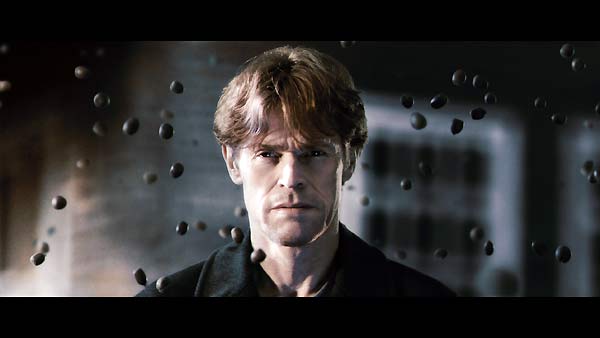
Antichrist is by far the most visually striking film that I've seen of von Trier's. He has abandoned the Dogme rules and embraced greenscreen to create stunning, darkly beautiful landscapes. The lush green forest is shrouded in fog and mist. The green screen and CGI are used to great effect in Dafoe's dream sequences, in which he seems to be showered in the acorns that pelt the cabin's roof at night. The gore is horrible, but the film would be nothing without the atmosphere, the oppressive nature of the forest. As She tells Him, "Nature is Satan's church"
It's also, as the reviews have pointed out, very violent. Yes, the genital mutilation is there, and it is graphic. But I believe that it does have a point. The message of Antichrist isn't quite the same as Michael Haneke's in his Funny Games, which is aimed at punishing people who enjoy violence on screen. Antichrist's gruesomeness serves its purporse, which I think is two-fold. First,showing that this is how far the character has gone, and this is the consequence, and secondly the symbolic meaning. Antichrist takes little bits and pieces from body horror, torture porn, religious horror, Asian horror, and classic "cabin in the woods" horror. It does seem to be largely interested in violence against women. She is writing a thesis on medieval violence against women, but has misinterpreted it in a way that is impossible to talk about without ruining the film.
As for the misogyny, I disagree. Von Trier does seem to have set up that accusation with some of the dialogue and choosing to name the characters the generic He and She. However, it's about the horror of violence against women, and how far back it goes. Again, I can't say too much about Her thesis, but the inclusion of the texts on witchcraft and demons is important.
It's not perfect. At times the events in the film seem to be not especially well thought-out. The ending doesn't quite work as well as it should, and the inclusion of the three animals is a bit much. But generally, Antichrist is a success. It's horrifying, pure and simple. Dafoe and Gainsbourg are superb. But at the same time, and this is always a solid defence of films such as this, you don't have to watch it. It certainly earns it's 18 certificate, but this isn't a gratuitous slasher gorno. This is arthouse horror at its most extreme. Von Trier has announced that his next film will be a science fiction apocalypse horror, with Penélope Cruz attached to star. What are the odds that someone will be upset?
The Last House on the Left Starring: Garret Dillahunt, Tony Goldwyn, Monica Potter, Sarah Paxton Written by: Adam Alleca, Carl Ellsworth, based on a screenplay by Wes Craven Directed by: Dennis Illiadis
This redo of Wes Craven’s ground-breaking, if not spectacular, horror has emerged with somewhat less fanfare that other recent remakes, but with considerably more critical approval. Unlike, say, My Bloody Valentine, it doesn’t rely on 3D gimmickry. It also doesn’t have the brand recognition of Friday 13th. It is, however, a very well-made little horror film. While Craven’s film seemed to have been made purely to make a name for the director, as well as seeing quite how much they could get away with, this is slick, but still harrowing stuff.
Mari Collingwood goes with her parents to their cabin in the woods. On arriving, she takes the car and meets up with old friend Paige in town. Enter Justin, a quiet young man, who tells them he has pot in his motel room. Mari reluctantly agrees and they accompany him to the motel. Shortly after, Justin’s family returns. A band of sociopaths led by Justin’s father Krug, they do terrible things to Paige and Mari. As night falls, the group take the shelter offered by John and Emma Collingwood. Which group will realise quite who they’re sharing coffee with first?
It’s usually a good sign when the director of the original film takes an active interest in the remake, and Craven is reportedly genuinely pleased with Illiadis’s interpretation. The Greek newcomer is certainly a director to watch. The first few scenes show off the beauty of the location and the filmmaker’s eye for colour and composition. He also handles the less pleasant scenes with a steady hand. The rape scene is difficult to watch, but not exploitative. The violence is brutal and gruesome, but also affecting.
The film is also very well-cast. Goldwyn and Potter are likeable as the parents and portray the shift from horrified to murderous with skill. Paxton and Superbad’s Martha MacIsaac are likeable teens, which makes what happens all the more difficult to watch. Breaking Bad’s Aaron Paul deserves a special mention as Krug’s brother Francis, as does Spencer Treat Clarke, best known for being “the kid” in Gladiator and Unbreakable, here playing the conflicted Justin. Clarke also works very well with Garret Dillahunt, who is the film’s clear standout. Krug is Dillahunt’s first real lead, but he’s been consistently excellent in supporting roles over the past few years. Playing not one, but two, villains in Deadwood, as well as smaller good-guy parts in The Assassination of Jesse James and No Country For Old Men, he’s able to play charming, funny, and sadistic, and he uses all three traits here.
It’s all a little old hat by the end, however. The problem with the remake is that most of us are familiar with the story, and we all know what’s coming. By the time that John and Emma figure it out, we’re way ahead of them and the ensuing horror is a little predictable. It’s not entirely without standout moments, but, apart from one particular incident, the violence in the third act is never as shocking as what Mari and Paige go through.
Of the recent run of horror remakes, The Last House on the Left is a long way ahead of the competition. Watch it if you've got a strong stomach. Oh, and I hate the last little scene. I really hate it.
Starring: Alison Lohman, Justin Long, Lorna Raver, Clark Gregg Director: Sam Raimi Screenplay: Sam Raimi and Ivan Raimi
As sophisticated audience members, we’re all used to hyperbolic statements adorning movie posters. Especially horror movie posters that scream “White knuckle thrill ride!” “You’ll be on the edge of your seat!”. We all know that, more often than not, these statements are incorrect. This is not the case with Sam Raimi’s Drag Me to Hell. After a long absence, the director has returned to the genre that he helped define with, well, a white knuckle thrill ride that will have you on the edge of your seat.
In terms of story, Drag Me to Hell is a very simple, straightforward tale. Loan officer Christine Brown is told she needs to be better with the tough decisions if she wants a promotion, and so refuses to help old Mrs Ganush who is being evicted from her home. Humiliated, the woman puts the terrible Lamia curse on Christine. The curse means that the victim will be tormented for three days before being taken to Hell. Cue shocks, delirious set pieces, and Sam Raimi cutting loose for the first time in years.
Those of us who saw at least one Evil Dead film before the release of Spider-Man will recall a sense of pleasant surprise when Raimi managed to adapt his distinctly individual style to a comic book franchise so skilfully. Spider-Man 2, in particular, remains one of the strongest comic book movies to date, capturing the tone of the source material while keeping a sense of authorship. Then came the disappointing Spider-Man 3, and the sense that the director had somewhat lost his way. He hadn’t made a horror film since The Gift, and even that was a sadly sub-par Southern Gothic ghost story. Thankfully, Drag Me to Hell shows that Raimi has lost none of his energy, and none of his ability to put audiences on edge.
From the riotous opening scene (brace yourself, seriously), Raimi grabs his audience by the throat and lets us know exactly what we’re in for. The film is at once wonderfully nostalgic (cloven-hoofed bestial shadows, gooey gross-out scares, terrifying old women are all present) and pleasantly self-aware. There’s even a couple of Evil Dead references for the faithful to spot. Then there’s the sheer volume. It’s a film that’s worth catching at the cinema, as the deafening sound effects will no doubt be lost on television. It’s not just about the jumps, though. Drag Me to Hell is, perhaps most of all, about the build-up. Raimi is a director that has always seemed to delight in punishing not only his actors but his audiences. With this new film, he finds a formula that is tried and tested and puts it to use over and over again. And this is part of what makes Drag Me to Hell work. We know what’s coming, and there’s absolutely nothing we can do about it. Christine’s boyfriend Clay is conveniently offscreen, the music drops, we move in for a close-up…and we’re off! It’s a tactic that is used several times during the film, but it works every time.
Raimi is helped not only by the deafening sound effects, and a highly effective score by Christopher Young, but by Alison Lohman’s central performance as Christine. It is common knowledge that Ellen Page was set to star but was forced to drop out, but to Lohman’s credit, she makes the role her own. She’s not helped by the script, with its occasionally duff dialogue and clunky back-story. Clearly, and understandably, Raimi is more interested in scaring the pants off us than establishing any sort of believable character arc. However, thanks to Lohman, we stick with Christine throughout her journey. It’s also a pleasant surprise that Christine isn’t the traditional scream queen. She’s resourceful (her fight with the old lady at the beginning is brutal), and she’s prepared to take drastic steps to save her own life (poor kitty…). There are also solid performances from Justin Long, who fares surprisingly well in the thankless “sceptic boyfriend” role, and from Lorna Raver as the evil Mrs. Ganush.
What Drag Me to Hell has over countless other recent horror films is a sense of fun. It never takes itself too seriously (there’s a talking goat at one point!), and the gruesome effects are wonderfully icky. Lohman takes a lot of punishment throughout, and the number of disgusting things she has to go through should earn her some sort of medal. I can’t convey with words quite how, well, jumpy the whole ordeal is, but it’s that rarest of things: A horror movie that delivers on its promise. And, best of all, Sam Raimi gets to show that he’s still got it.
A word of warning. I imagine that Drag Me To Hell will lose a lot of its impact on DVD. For maximum effectiveness, turn the lights off and turn the volume up until it hurts!
Well, Halloween's gone now. All we're left with is the slow realisation that the fake blood probably won't wash out of the white shirt, and what to do with that jack o'lantern...it's going to rot.... Anyway, here's one last little Halloween themed post.
TRICK 'R' TREAT
The path of Trick 'r' Treat to any sort of audience was not a simple one. Due for release in 2007, the film was finally released straight to DVD just in time for Halloween this year. Despite the fact that the few early reviews were universally positive, the film kept getting pushed further and further back. Interesting marketing strategy, eh? Whenever I'd hear something about it my interest would be piqued. Then I'd get to the end of the article or review and I'd see that the film had been pushed back...yet again. But now it's out, and I've finally seen it. And it's very good.
The film is similar in structure to the classic George A. Romero/Stephen King collaboration Creepshow, or the less classic Tales From the Darkside Movie, in that it has several interlocking stories. Unlike the older films, however, all the characters are involved in all the stories, rather than having one narrator, and it all takes place on Halloween night. It opens with a couple (Leslie Bibb and Tahmoh Penikett) debating whether or not to get rid of their Halloween decorations, with impressively gory consequences that set the tone for the film. School principal Steven (Dylan Baker) decides to teach a jack o'lantern-trashing kid a lesson he won't forget, Laurie (Anna Paquin) feels pressured by her older sister to find a date for the big party in the woods, a group of kids decide to find the remains of a schoolbus full of murdered special-needs children, and cranky shut-in Mr. Kreeg (Brian Cox) is tormented by a violent supernatural monster that may be linked to his past.
In the studio's defence, it's easy to see that the film is almost impossible to market for anything other than a niche audience. Given that the closest point of comparison is Creepshow, how do you get a Saw audience to watch this? Too scary and gory for the PG-13 crowd, and too funny and strange for the torture porn fans. For fans of older horror, however, Trick 'r' Treat is a definite treat (Oh yes, that pun's intended). It's clever and funny enough to be a reference-filled Scream sort of film, but it never actually goes into parody. Writer/director Michael Dougherty balances the laughs with some genuine scares and some nasty gory shocks. The script is also full of excellent little twists and turns that subvert expectations rather than cheat them.
It helps that the film is cast superbly. Anna Paquin plays the Little Red Riding Hood of her group, and it's strange to think that the film was made before True Blood as a man in a vampire suit stalks her through the forest. Brian Cox has fun as the cranky hermit, all straggly hair and muttered curses. The children in search of the lost school bus are also excellent. Best of the lot, though, is Dylan Baker. Playing the creepy killer school principal, he carefully treads the line of over-the-top mugging and genuinely scary. It's a reminder that he's an underrated actor, and deserves more than the meager screen-time he's often given.
The problem with Trick 'r' Treat is that it's all over a little too quickly. Arguably, it's a good thing that we're left wanting more. However, it would have been nice to give the characters a bit more time (Baker is short-changed, as is Paquin). But it's funny, scary, and it's everything that a Halloween movie should be. Dougherty has said he'd like to make more with the film's mascot Sam as the returning character, and hopefully they'll let him. Seems unlikely.
Right, now that we've done our woefully brief overview of slasher boogeymen, we thought that, instead of going through genres at a the pace of a knackered snail, we'd tell you about the films we really like. Subgenres be damned, here are our horror favourites....
AN AMERICAN WEREWOLF IN LONDON (1981)
It's arguably the best werewolf film ever made, and also one of the most successful horror comedies. It's John Landis' finest hour, showing that the man who made The Blues Brothers and Animal House knows his scary movies. The film starts with young Americans David Kessler and Jack Goodman roaming the highlands of Scotland. They stumble across The Slaughtered Lamb, a pub full of unwelcoming locals who tell them to "Beware the moon" and "Keep to the Road". Needless to say, they wander onto the moors and are attacked by a savage wolf. Jack is killed, but David wakes up in a London hospital. The good news is that he's being attended to in more ways than one by nurse Alex Price (Jenny Agutter), the bad news is that he's turning into a werewolf
What can we say about American Werewolf in London? It's got the best "awkward silence in a busy pub caused simply by your arrival" moment in cinema history. It's got a fantastic transformation courtesy of effects maestro Rick Baker. The performances from David Naughton and Griffin Dunne are so convincing that you essentially think that they're playing themselves (the commentary on the DVD certainly does little to dissuade you of this). Jenny Agutter is appropriately lovely as Alex, and, surprisingly for an American made film set in England, the English dialogue actually sounds right. The dark comedy contrasts excellently with the genuinely scary scenes (that underground chase scene is still spooky), and the surprisingly effective gore. It's got that invaluable trump card: Brian Glover. Here's the Slaughtered Lamb sequence for your viewing pleasure:
Want a werewolf movie this Halloween? Rent this. Better yet, buy it. Beware the moon, lads.
Go further: The Howling, Ginger Snaps, Dog Soldiers
SUSPIRIA (1977)
Taking a left turn here, Dario Argento's classic mindbending nightmare is perfect for those who want something a little different this Halloween. Suzie Banion arrives at a German dance academy, only to find something terrifying is roaming the school at night. And, basically, that's it. There are some odd plot details, such as Suzie trying to make friends, and a young, dubbed, Udo Kier pops up near the end to explain what you might have figured out already. But, as any Argento fan will tell you, if you're following the plot properly you're just going to get a headache. The plot of Suspiria is a flimsy excuse for the director to indulge in gloriously gory set-pieces, fantastically insane camera work, brightly lit in primary colours and scored with Goblin's metal music. Trying to explain what makes Suspiria so good is difficult. It's a technicolour nightmare, a blood-soaked fairytale. And it's tremendous fun. So, basically, go and watch it.
Go further: Inferno, Profondo Rosso, Tenebrae, Opera
OK, chances are you've probably seen The Ring, and The Grudge. But A Tale of Two Sisters manages to be a genuinely scary horror even if you're familiar with the "evil lank-haired girl" routine. The film is about two sisters who begin to suspect that their new, attractive stepmother may have killed their mother. It's essentially a haunted house movie, but these bangs and jolts are perfectly done. It's perfectly played by the cast, and is shot and scored with the care and artistry than an award-bait drama would normally be given. It's also more about the chills than the gore, building up suspense slowly and expertly until, inevitably, someone breaks. A Tale of Two Sisters is an excellent twist on the wicked stepmother story, and the sound of fingernails on wood is one that will stay with you for days. Oh, and it was recently loosely remade as The Uninvited, starring David Strathairn and Elizabeth Banks. Reviews were less than favourable, so, as is so often the case, it's best to stick with the original.