
"I know you've heard colorful rumors about what an 'Active' is. Robots, zombie slaves — they are, of course, quite the opposite. The 'Active' is the truest soul among us."
It always seemed inevitable that Dollhouse would be cancelled. When it was announced that Joss Whedon would be making his latest series at Fox, Whedonites started a website campaigning to save the show before a single episode aired. Looking back now with some perspective, how will Dollhouse be remembered? In the larger context of Whedon's work, the series is probably the least successful, coming in a long way behind Buffy, Angel, and Firefly. But at its best, Dollhouse was miles ahead of genre shows currently on television.
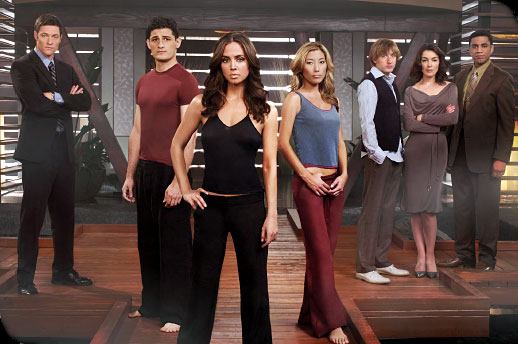 The idea for Dollhouse apparently came about during a lunch Whedon had with Eliza Dushku, when they discussed possible ideas for a vehicle for her. The premise, at least in the week-to-week sense, is fairly simple. The dollhouse is a secret worldwide organisation which brainwashes beautiful young people into "Actives", and hires them out to wealthy clients, having programmed them to be whatever the clients want. When they return, they are wiped clean and spend their days in a child-like, memory-free state while they wait for their next assignment. The Los Angeles dollhouse is run by glamorous Brit Adelle DeWitt (Olivia Williams), with staff including amoral genius Topher Brink (twitchy and funny Fran Kranz), short-tempered security chief Laurence Dominic (Reed Diamond), scarred and sympathetic Dr. Claire Saunders (Amy Acker), and tough-but-gentle handler Boyd Langton (an excellent Harry Lennix. Apart from the fact that FBI agent Paul Ballard (over-earnest Tahmoh Penikett) persists in searching for them, everything is running smoothly. If one of the dolls malfunctions, they're sent to the attic. But one of the dolls, Echo (Dushku), starts to remember her assignments and retains the skills she is given.
This being a Joss Whedon show, there's a big bad company that will bring about the end of the world, the very different characters end up banding together to form a makeshift family, and the dialogue is often excellent. When Dollhouse picks up speed, it's snappy, gripping television. But when Dollhouse was bad, it was infuriating.
 So what's wrong with it? Well, it got off to a bad start. We were told by the makers that Dollhouse episode 1 would not be the pilot, instead it would be a "mission of the week" installment which aired amid a howl of anguish from the wronged Whedonites. And while we got some nice insight into the workings of the Dollhouse (a theme that would continue to be very strong), the story, about Echo being programmed to be a hostage negotiator, was frankly dull. Echo's plotline was not interesting, and it was the A plot. Episode 2 introduced the big bad Alpha, but kept him offscreen while giving us a Most Dangerous Game storyline in which Dushku was chased around a national park by Matt Keeslar. Nothing we hadn't seen before. The next episode would prove to be the show's worst hour: Echo is programmed to be a backup singer/bodyguard for a pop diva whose stalker may turn deadly. It's one of the worst things Whedon has ever been associated with. The next two mediocre episodes were frankly a relief. But that's five sub-par episodes in a row. Not how you want a TV show to start, especially one that most people are convinced won't last long.
 Then, suddenly, Dollhouse got good. Whedon issued a statement telling fans to wait for episode 6, which he said would finally get the plot going and introduce what he was actually trying to with the show. Sure enough, "Man on the Street" was what we were hoping Dollhouse would be. Clever, with adult themes, and moral ambiguity. This rise in quality continued with "Echoes" and "Needs", which pushed the arc forward. Dollhouse was now a must-see. The last two aired episode, "Briar Rose" and "Omega", finally introduced Alpha, a wonderfully psychotic Alan Tudyk, who showed us just how wrong the dolls can go. The slow build gave way to sudden, shocking violence. While the ending was a little rushed, we were left hoping for a second series.
But nobody thought that Fox would bring Dollhouse back for a second series. Yes, the reviews had gone from indifferent to enthusiastic, but the viewing figures were still low. It didn't help that Fox decided not to air "Epitaph One", the last episode of the series. The episode was set in the future and we were shown how technology created by Topher led to the apocalypse. Characters were changed, switched around. Topher was a hysterical wreck, and Adelle had become a motherly figure to him and the others who had barricaded themselves inside the dollhouse against the outside world. in an episode that was both scary and fun in a postapocalyptic way. It was geniunely exciting, it gave us clues as to the final end of the show, and we had to wait for the DVD to get it. But then Fox announced that Dollhouse would be coming back for another thirteen episodes, and we got all excited again.
We hoped that Dollhouse had got over the troughs in quality that the first series had suffered from, but we were wrong. The start of the second series was very much a mixed bag. Amy Acker, so good as the scarred Dr. Saunders in the first series, was no longer a regular. For every good episode (Belle Chose and Belonging were superb), there was an Instinct. Good guest stars (Keith Carradine, Ray Wise, Summer Glau) couldn't help make episodes like The Public Eye much more interesting. As Christmas approached, Fox announced that they would be airing two episodes back to back two weeks running. Then they announced that Dollhouse would not be coming back for a third series.
And just like that, Dollhouse kicked back into gear. The pace was, necessarily, tightened, as the overlong government conspiracy plotlines were condensed to make room for as much character and plot development as possible in the time available. Topher develops a moral compass! Whose side is Adelle on? And what's in the attic? The last six episodes were fantastic.
 Perhaps most importantly, Whedon had time to wrap up the series. Unlike his other shows, he has said he has no intention of a comic book spinoff, or any attempts to revive it. Dollhouse is finished, and it finished well. But maybe the overwhelming feeling about Dollhouse is disappointment and a sense of a missed opportunity. It got two series, one more than Firefly. It was given time to tie up most of the loose ends. And, with Epitaph Two, it had two episodes set in the future, meaning that both present and future plot-lines were resolved, which is pretty cool.
So what was the best part of Dollhouse? No, not Echo. Frankly, I found Dushku, her missions of the week, and her relationship with Ballard pretty tedious. Strange that the apparent main plot-line of the series was the least interesting. No, the best part was the dollhouse itself. The really interesting arc was never Echo's, with her struggle to bring the dollhouse down with her accumulated memories. No, the best was the power struggle between the LA dollhouse staff and their employers, the evil Rossum corporation. The dollhouse itself had so many interesting areas that were underexplored. That said, at least we finally got to see the attic
 The best characters were the ones within the system. Olivia Williams was superb as Adelle DeWitt, consistently keeping us guessing as to who exactly she was playing for and showing impressive comic timing to go with icy mercilessness. Fran Kranz was a revelation as Topher, who slowly begins to realise that his actions will cause the apocalypse and discovers that he does care. Also impressive finds were Dichen Lachman and Enver Gjokaj as dolls Sierra and Victor. Both manage to do more with their different personalities than Dushku in much less screentime, and get two of the best episodes dedicated to their burgeoning romance. Oh, and Gjokaj does an excellent impression of Fran Kranz. Amy Acker was also great, despite being only an occasional presence, but makes the most of her screentime. Another Angel alum, Alexis Denisof, fares worse in a tedious run of episodes as Senator Perrin who is trying to expose the Rossum corporation, although Summer Glau was a very welcome guest star as Topher's opposite number in Washington, Bennett Halverson.
This is somewhat rambling, but it's difficult to sum up how I feel about Dollhouse' cancellation. In a way it's good that it got wrapped up. It sounds cruel, but when they were under pressure the writing seemed to be so much better. But then again, the show had so much potential. I'm going to miss tuning in to watch Adelle's scheming, Topher's panicked ideas, Gjokaj's hilarious performances when being inhabited by Topher. When Dollhouse was good, it ranked with Whedon's best work. But it was too inconsistent. At least it went out with a bang. And how do you know that you care about a television show? When characters are hurt or killed, and it upsets you. Nobody does that like Whedon, and hey, I cared about these characters.
Best Whedon moment: Subliminal messaging. "There are three flowers in a vase...the third flower is green". That, and the invention of the word "thoughtpocalypse"
Best character: It's a tie between Adelle and Topher. Both Williams and Kranz got the biggest emotional arcs of the characters. For the most part Williams did icy menace while Kranz did comic relief, but check out "Echoes", in which their characters are reduced to a childlike state. Topher: "What's brown sauce made of? Science doesn't know!" Adelle: "It's made of brown!" Topher: "Brown...mined from the earth by the hard scrabble miners of North Brownderton!" Adelle: "My god...I find lentils completely incomprehensible!"
Best violent shock: Tough call, but right now I'm going with the flashback where we see Alpha flip out and first leave his signature on his victim's face. "Let Echo be number one"
Best episode: Damn tricky. I'm going with Needs. Or Spy in the House of Love. Or The Attic. Or Epitaph One. Or Getting Closer, and The Hollow Men...............
Worst episode: Stage Fright. No contest.
One line to sum it all up: "You don't know me! That's the contract. You don't know me, and I don't know you, not fully, not ever! I made you a question. I made you fight for your beliefs. I didn't make you hate me. You chose to."


