Mesrine: Killer Instinct Mesrine: Public Enemy Number 1
Starring: Vincent Cassel, Cécile de France, Ludivine Sagnier, Gérard Depardieu, Mathieu Almaric, Elena Anaya, Samuel le Bihan Screenplay: Abdel Raouf Dafri and Jean-Francois Richet Director: Jean-Francois Richet
As the success of Jacques Audiard's The Beat That My Heart Skipped showed, we're all partial to a cool French gangster movie. Take that genre, add a fantastic cast led by Vincent Cassel, a breakneck pace, 70s setting, and Richet's flashy but firm direction, and you've got something rather special.
Split into two parts, the films tell the story of Jacques Mesrine, a real-life French gangster, bank robber, kidnapper, and murderer from his days in Algeria up until his death, shot down by police in Paris. Cassel is perfectly cast as Mesrine, bringing charisma and sponteneity to the character. It's quite the task to keep the same character interesting for two films, but Cassel is more than up to the task.
Killer Instinct, the first of the two, is probably the better film. It moves so quickly that pretty much the only way to keep track of the passing of time is how many children Mesrine has with his first wife, Sofia. Heists, murders, wives, accomplices all pass by with lightning quick. Cassel's standout performance is backed superbly by an on-form Depardieu as Mesrine's first boss Guido, Gilles Lelouche as his old buddy who gets him into the gangster life, Elena Anaya as his suffering first wife and mother of children, and Cécile de France as his soul-mate second wife who joins him on his life of crime, Jeanette Schneider.
The film never really slows down, from Paris to his journey to Canada, to his arrest in America, to his breathtaking escape from the Canadian prison. Maybe things move a little too quickly, but it's shot with such panache and performed with such enthusiasm that there's really very little cause for complaint. You can't help but be caught up in the excitement of it all.
Things slow down considerably with Public Enemy No.1, although it starts with a lightning quick daring escape, as Mesrine manages to flee his own trial. The second film also suffers a little from overfamiliarity. There's another moll (Ludivine Sagnier), another prison break with another accomplice (Mathieu Almaric). There's nothing wrong with any of these things, but we know where it's going. Sagnier is a nice counterbalance to the aging Mesrine, an excitable girl who's won over by the money and fun, and Almaric does twitchy nervousness very well.
Perhaps what Public Enemy No. 1 does most importantly is show the bad side of Mesrine himself. There's one particular moment in the first film when Mesrine attacks his wife (Anaya), and shoves his gun in her mouth. It's these moments that remind us that Mesrine may be the hero of his own life, but to us he is a criminal. Public Enemy shows us more of these moments, climaxing in the brutal murder of a journalist who had the nerve to criticise him. It also makes much more of an effort to understand Mesrine. As he grows older, Mesrine realises the inevitability of his own death, while simultaneously falling in love with the image he has created for himself.
Both films are very well-written, and fantastically shot. I was only familiar with Richet's better-than-it-should-have-been remake of Assault on Precinct 13, but his spontaneous style works fantastically. Mesrine also goes straight onto the short list of films that actually use split screen very well, as it gels naturally with the overall feel of the two films.
The two Mesrine films absolutely deserve their rapturous reception. They are wonderfully acted, excellently shot, and, above all, magnificently entertaining.
Pontypool Starring: Stephen McHattie, Lisa Houle, Georgina Reilly Written by: Tony Burgess, based on his novel Director: Bruce McDonald
"Sydney Briar is alive. Sydney Briar is alive. Sydney Briar is alive"
If you think we've seen too many vampire films recently, cast your mind back to a few years ago and remember the glut of zombie movies. After the success of 28 Days Later, Shaun of the Dead, and the Dawn of the Dead remake, multiplexes were flooded with different takes on the subgenre. After a while things seemed to die down and occasionally we'd get a really good zombie movie, like Rec. We're at a level now where the word "zombie" won't provoke a sigh of boredom, and it's nice to have that back again!
So, Pontypool is a 2008 film from Canada, that director Bruce McDonald would prefer we wouldn't call a zombie movie. Sorry, Bruce, but it is the easiest way to describe the film without resorting to a made-up word. It's only got one recognisable face in Watchmen star Stephen McHattie (he played the first Nite Owl), it's low budget and it takes place almost entirely in one location. And it works. Shock-jock Grant Mazzy (McHattie) has fallen from grace. He's now working for the local radio station in Pontypool, that operates out of the town's church basement. The show's producer Sydney (Lisa Houle) is getting tired of his attempts to make the local news inflammatory, while the young assistant, Laurel-Ann (Georgina Reilly), is a little smitten with him, sneaking scotch for his coffee. Then the "Sunshine chopper", which is in fact a man sitting in his car on top of a hill, reports that people have started attacking each other. Before long the whole town has gone mad, and the three must find out how to avoid being infected with the strange virus.
Bruce McDonald has stated that Orson Welles' War of the Worlds broadcast was the touchstone for this film, and what a fine touchstone to have. It's always nice to see character actors take on a leading part, and McHattie is superb. An irreverent hero in the finest 70s tradition, it's largely his performance that keeps us so involved, as Mazzy goes from wry sarcasm to geniune terror. Houle is also good as the single mum producer, and Reilly is effective, although given less to work with.
The idea of Pontypool's virus is an interesting one. Essentially, certain words have somehow become infected. The easier they are to understand, the quicker they are poisoned. At around the 20 minute mark, a French language announcement hijacks the radio station's signal. Mazzy and Sydney translate it, reading it out as they go. As Mazzy speaks, they get to the troubling end of the message: "Do not translate this message". The key to surviving, it seems, is to not speak English.
Technically speaking, the infected in Pontypool aren't zombies. They aren't undead, they are just brainless, focusing in on people's speech. However, the familiar tropes of the zombie film are present and correct. The infected vomit blood, they besiege the church in which Mazzy and his team have barricaded themselves. And there's the familiar social commentary. The army arrive, shooting people indescriminately, and they soon become as much of a danger to our heroes as the infected.
Unfortunately, the film is so enamoured of its premise that some tension is lost in the final third as the plot is explained over and over again. While the idea is complicated, it doesn't require quite the amount of exposition that the film gives it. The horror takes a back seat as Mazzy and Sydney discuss how to avoid infection. It's interesting, but not quite as gripping as the first two acts. Overall, Pontypool is an intelligent, exciting entry in an overcrowded subgenre, and is well worth seeking out. McHattie is superb, and I look forward to the sequel, already in production, Pontypool Changes. Apparently, if the second is a success, a third film is written, Pontypool changes everything. It's also well worth sticking around for the end credits, as a nice little coda rounds things off in great style.
Antichrist Starring: Charlotte Gainsbourg, Willem Dafoe Written and directed by: Lars von Trier
"A crying woman is a scheming woman"
Don't watch this if you're squeamish, or if graphic gore and/or nudity upsets you. There, that's done.
Antichrist certainly kicked up a lot of controversy when it was released at Cannes. Critics were subjected to a film that was not only deeply unsettling, but apparently misogynistic and featuring graphic scenes of genital mutilation. When one particularly self-righteous journalist from The Daily Mail demanded that von Trier justify himself, von Trier told him that he didn't have to. He told the assembled critics that they were his guests, and that he was the greatest filmmaker alive.
What is most surprising to me is that any of the Cannes critics were surprised that they were offended. When a filmmaker as controversial as Lars von Trier says that he's made what he called a pornographic horror film, anyone who has heard of even one of his films braces themselves. This is the man whose most mainstream films are Breaking the Waves, Dancer in the Dark, and Dogville, three incredibly emotionally bruising works. And he says he's made a horror film? I saw Antichrist expecting to be shocked and upset, and I was not disappointed in that regard.
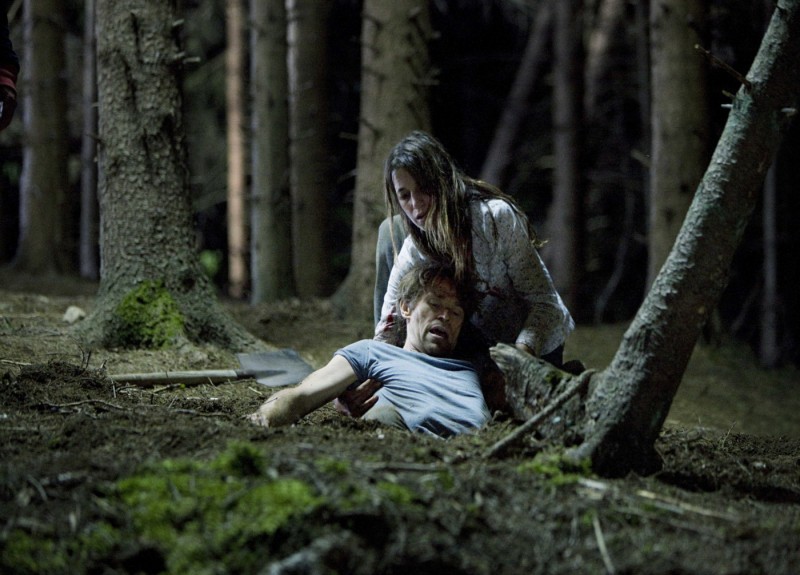
The film starts with a strikingly shot black-and-white slow-motion sex scene between He and She. As they make love, their young son gets out of his cot and falls through the open kitchen window to the street below. Hysterical with grief, She is hospitalised and medicated. He, a therapist, is convinced that he knows what is best for her and decides that she needs to face her darkest fears. He establishes that she is most afraid of Eden, the forest where they own a cabin. The two of them trek up there, as He makes her confront the things that she is afraid of. However, all is not right at Eden. He begins to realise that he has made a terrible mistake, and that She is not getting better.
First things first, Antichrist unsettled me deeply. It's horrifying, troubling and upsetting. There's been some lively critical debate as to whether the whole thing is just a big joke, with Mark Kermode in particular believing that von Trier is giggling behind each frame. Well, that may be the case. It's always difficult to gauge what he's up to, but I found the film to be an almost entirely successful horror film. It's adult, it takes its time, and I can't think of many films that present such horrific situations without a single note of humour. That said, there are moments where it's almost a little to ridiculous. Shortly after arriving, Dafoe sees a deer with a miscarriage hanging from its haunches. Disgusting and unnerving yes, but that's got nothing on the fox gnawing at its own entrails that looks up and tells Dafoe that "Chaos reigns". It's ridiculous, but the atmosphere is so overpowering, and the performances so committed that, for me at least, Antichrist is very much a po-faced horror.
Speaking of the performances, they are utterly fantastic. Dafoe has the less showy part. He makes his character complex enough so we're not quite sure if we're rooting for him early on. He is so convinced that he's right that he does seem to be risking Her mental and physical health early on when he decides to take Her off her medication. The slightly smug condescension soon turns to horror as he realises what's going on with Her.
Charlotte Gainsbourg is stunning as She. Gainsbourg has played both unsympathetic (21 Grams) and sympathetic (I'm Not There) before, but I've never seen her give such a powerfully raw performance. Her grief is incredibly physical in the first part of the film. Both Dafoe and Gainsbourg give brave performances, but hers is tremendously so. The levels of nudity and violence are such, and they're often combined, that you have to admire the bravery in just signing on to do the part. It represents a narrow-mindedness on the part of most awards bodies that Gainsbourg has not been nominated for any prizes (although she deservedly won the Best Actress prize at Cannes).
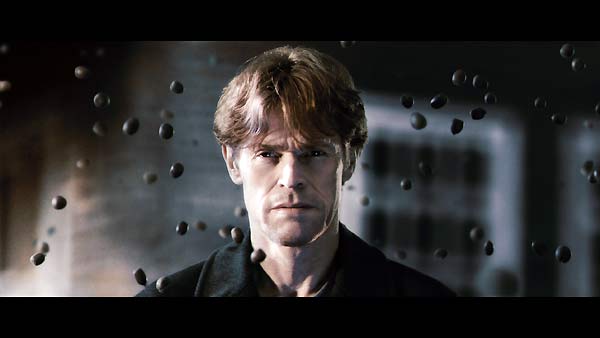
Antichrist is by far the most visually striking film that I've seen of von Trier's. He has abandoned the Dogme rules and embraced greenscreen to create stunning, darkly beautiful landscapes. The lush green forest is shrouded in fog and mist. The green screen and CGI are used to great effect in Dafoe's dream sequences, in which he seems to be showered in the acorns that pelt the cabin's roof at night. The gore is horrible, but the film would be nothing without the atmosphere, the oppressive nature of the forest. As She tells Him, "Nature is Satan's church"
It's also, as the reviews have pointed out, very violent. Yes, the genital mutilation is there, and it is graphic. But I believe that it does have a point. The message of Antichrist isn't quite the same as Michael Haneke's in his Funny Games, which is aimed at punishing people who enjoy violence on screen. Antichrist's gruesomeness serves its purporse, which I think is two-fold. First,showing that this is how far the character has gone, and this is the consequence, and secondly the symbolic meaning. Antichrist takes little bits and pieces from body horror, torture porn, religious horror, Asian horror, and classic "cabin in the woods" horror. It does seem to be largely interested in violence against women. She is writing a thesis on medieval violence against women, but has misinterpreted it in a way that is impossible to talk about without ruining the film.
As for the misogyny, I disagree. Von Trier does seem to have set up that accusation with some of the dialogue and choosing to name the characters the generic He and She. However, it's about the horror of violence against women, and how far back it goes. Again, I can't say too much about Her thesis, but the inclusion of the texts on witchcraft and demons is important.
It's not perfect. At times the events in the film seem to be not especially well thought-out. The ending doesn't quite work as well as it should, and the inclusion of the three animals is a bit much. But generally, Antichrist is a success. It's horrifying, pure and simple. Dafoe and Gainsbourg are superb. But at the same time, and this is always a solid defence of films such as this, you don't have to watch it. It certainly earns it's 18 certificate, but this isn't a gratuitous slasher gorno. This is arthouse horror at its most extreme. Von Trier has announced that his next film will be a science fiction apocalypse horror, with Penélope Cruz attached to star. What are the odds that someone will be upset?
I've been a big fan of British writer/director Neil Marshall since his unashamedly entertaining squaddies vs. werewolves movie Dog Soldiers. He became a critical darling after the release of excellent horror The Descent, but lost some brownie points after Doomsday was a critical and commercial disappointment. Personally, I enjoyed Doomsday so much that I went to see it twice. Marshall is a superb genre filmmaker, and now he's bringing us Centurion. Centurion is the story of the survivors of the Ninth Legion as they struggle to escape from rampaging Picts. The cast is impressive, led by Michael Fassbender (Hunger, Inglorious Basterds) as Quintus Dias, the leader of the survivors, and The Wire's Dominic West. Bond girl Olga Kurylenko stars as the head of the Pict clan chasing after our heroes, and Liam Cunningham, Noel Clarke and David Morrisey round out the cast. Fassbender has described it as a "chase movie", and the good cast and lean premise should appease those upset by Doomsday's excesses. There hasn't been a decent Roman movie for a while, and it looks like Centurion might fill the gap. Centurion comes to UK cinemas in April Here is the trailer:
Following Ben's idea to write a top 5 cancelled TV shows list, I decided to strike out with blazing originality, and write my own. Yes, that's how we do things around here. So, here are my five unjustly terminated small-screen programmes.
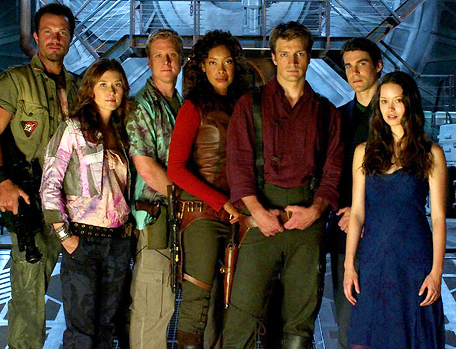
1. Firefly (2002-2003) This is the one that is still pretty much the benchmark of unfair cancellations. Nerds everywhere still get angry about Firefly being shut down, myself included. Joss Whedon's superb space western show lasted an all-too-brief 14 episodes, only 11 of which were aired. Those 11 were shown out of order. And Fox wondered why ratings were low. The show's merry band of smugglers, led by war veteran Malcolm Reynolds (Fillion), move from job to job, struggling to keep ends meet and keep flying. Oh and there's the evil alliance, who are hunting down River and Simon Tam who are being sheltered on board. Yes, it's kind of a niche show, but the DVD sales were enough to convince Universal to pay for feature film version Serenity, which was just as excellent. It's my favourite Whedon series, and it introduced us to the talents of Nathan Fillion and Summer Glau, and made cult heroes out of Adam Baldwin and Alan Tudyk. The dialogue was fantastically quotable, the characters wonderfully well-drawn, and it achieved the rare feat of making a show about smugglers on a spaceship feel both intimate and thrilling. From Fillion's Captain Mal and Baldwin's not-too-bright muscle Jayne, to Jewel Staite's shiny happy mechanic Kaylee and Glau's damaged-but-deadly runaway River, we cared about each of the great characters. Why can't we have more? Best episode: Either "Jaynestown", in which Jayne (the ship's muscle) finds out that he's a Robin Hood-esque folk hero to an oppressed small town, or "Objects in Space", where a mercenary gets more than he bargained for while trying to abduct River. Best quote: That's tough. Everyone gets great lines in Firefly. River: "I can kill you with my brain". Jayne: "I get ten percent! Let me do the math here, ten percent of nothin'...nothin' and a nothin' , carry the nothin'... Why it was cancelled: Not enough people watched it. And Fox are the devil Sum it up: "We're still flying" "That's not much." "It's enough."
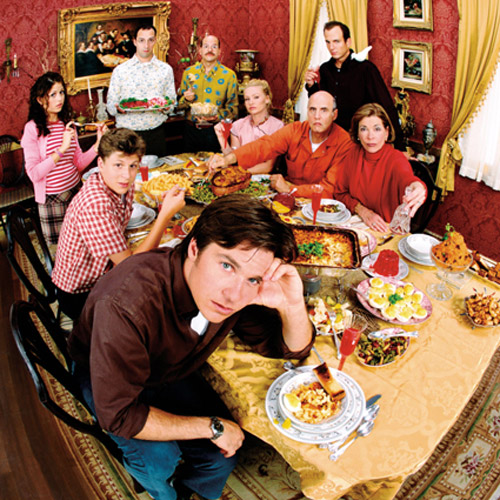
2. Arrested Development (2003-2006) This is one of those shows which got a huge amount of critical acclaim, but too few viewers. Star Jason Bateman described AD as "The Royal Tenenbaums meets Cops", which is an accurate distillation of the combination of witty family feud driven dialogue and the documentary-style hand-held camera work. Bateman played Michael Bluth, the only normal-ish member of the spoiled Bluth clan who lost all their money. It made stars out of Bateman, Will Arnett, Michael Cera, and David Cross and has created the kind of fanatical following that only a cancelled cult show can. Comparisons to Seinfeld are completely justified, as are comparisons to the still-running 30 Rock. It's wacky, and the third series was admittedly too wacky for its own good, but it was tempered with awkwardly believable situations, great characters and dialogue that is more quotable than Firefly. Now, what network was this on again? Best episode: I'm going with "Pier Pressure", in which Michael and Gob suspect Michael's son George Michael (Cera) of smoking marijuana and decide to teach him a lesson. Best character: It's a tie between Michael's magician (and ex-stripper) brother Gob (Arnett), and his hapless therapist turned aspiring actor brother-in-law Tobias (Cross). Michael's parents (Jeffrey Tambor and Jessica Walter) come a close second though. Why it was cancelled: Not enough viewers. Oh and Fox are the devil Sum it all up: "There's been a lot of lying in this family" "And a lot of love" "More lies"
3. Deadwood (2004-2006) David Milch's foulmouthed Western couldn't have really been made at any other network than HBO. It was expensive, defiantly adult and even more defiantly literary. The dialogue was often deliberately oblique, and sometimes the cusses were almost the only comprehensible words. But it had one of the best casts on TV, led by Ian McShane, proving he was more than Lovejoy with his blistering performance as Gem Saloon owner, murderer, pimp, and civic minded Al Swearengen. He was backed up by Timothy Olyphant (ostensibly in the lead) as the Sheriff with a short fuse Seth Bullock, Brad Dourif as the town Doc, Powers Boothe as Al's rival, John Hawkes as Seth's partner Sol Starr, Molly Parker as the heroin-addicted widow Alma Garrett, Garret Dillahunt playing not one but two muderers, and Keith Carradine as the legendary Wild Bill Hicock. Milch showed the west as it was: dangerous, blood-soaked, disease-ridden. Like Unforgiven, the characters cling to what they know as the march of progress threatens to replace them with a greater evil. The show occasionally got too involved with the Machiavellian workings of the town as it struggled to give up its non-Union status and become part of a state, but when it gained momentum it was superb. Best character: Al Swearengen. Without a doubt. Best quote: "Now, here's my counter offer to your counter offer - go fuck yourself!" Best episode: Either "Suffer the Little Children", in which two con-artists get a brutal lesson, or "A Lie Agreed Upon Part 1", if only for Al's bloodsoaked greeting to Bullock's wife: "Welcome to fuckin' Deadwood!" Why it was cancelled: Ratings weren't high enough for the very expensive show. Sum it all up: "Don't I yearn for the days when a draw across the throat made fucking resolution"
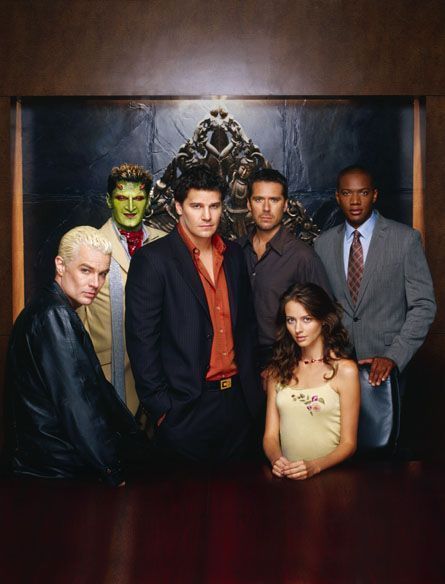
4. Angel (1999-2004) Yup, it's another Joss Whedon show. Given that he created Buffy the Vampire Slayer, you'd have thought that Fox would cut him some slack. No such luck. That being said, Angel had the longest run of any of the series on this list with a full five series. Unlike Firefly, there's a lot of episodes to watch and immerse yourself in. Angel was one of those rare things: a very good spinoff. Taking the character of Angel (David Boreanaz), the-vampire-with-a-soul, from Buffy and moving him to LA where he founds what is essentially a PI service with Cordelia (Charisma Carpenter), another second-string Buffy character, and an Irish half-demon sounds like a bad joke. But it worked. Admittedly, it wasn't until the second and third series that Angel really settled into a groove with the addition of Giles-esque Wesley (Alexis Denisof), significantly altered from his Buffy incarnation, ditsy nerd Fred (Amy Acker) and vampire hunter Gunn (J. August Richards). Things got very shaky with the addition of Angel's angst-ridden teen son Connor in series 4, but they got rid of him for series 5 and brought punk vampire Spike (James Marsters) in from Buffy in an inspired stroke. The show was cancelled halfway through series 5 and the last episodes do seem a little rushed, but they are among the show's best. Acker is especially good as Fred and warrior goddess Illyria, Denisof comes into his own in the last series, and Marsters gives the series the sense of humour it needed so desperately. Best character: Up until series 5, I'd say Wesley or Fred. Series 5, it's a tie between Spike and Illyria. I do dearly love the scenes in which Spike has to test her abilities. "She can hit like a Mack truck, selectively alter the flow of time, and, er, possibly talk to plants." "I enjoy hitting Spike. He makes noise." Best quote: Spike: "You're a wee little puppet man!" or Spike: "This next one's called "The wanton folly of me mum"!" Best episode: Either Smile Time, in which Angel is turned into a puppet, or A Hole in the World, in which Whedon shows us that he's prepared to kill off the nicest character even if it makes us cry. Why it was cancelled: Dropping viewing figures. And because Fox are the devil
5. Freaks and Geeks (1999-2000) Before Judd Apatow was the Grand Lord General of Hollywood comedy, he was the producer of this much-loved but short-lived high-school comedy set in 1980. Deliberately and lovingly focussed on the kids who serve as the butt of jokes on most high-school shows, it deserved much more attention and a longer run than the one series gave it. Starring Linda Cardellini as Lindsay Weir and John Francis Daley as her younger brother Sam, it was about both of their groups. Lindsay is a maths geek who decides to become one of the stoner gang (the freaks), including Daniel Desario (James Franco), Nick Andropolis (Jason Segel) and Ken Miller (Seth Rogen), and Sam is a nerd who is trying to get the girl of his dreams with the help of his two friends Bill Haverchuck (Martin Starr) and Neal Schweiber (Samm Levine). Freaks dealt with traditional issues like the first beer and the first kiss in a way that wasn't old and tired, and also gave us heartbreaking situations like Neal finding out that his dad who he admires so much is having an affair. It was as funny as the best teen comedies and touching in a way that noughties youth indies couldn't match. Best episode: Either "The Garage Door", with Neal's discovery, or "Chokin' and Tokin'", in which Lindsay smokes weed and allergic Bill is fed peanuts by a bully and falls into a coma. Best character: Either the so-uncool-he's-cool Harris (Stephen Lea Sheppard) or hippie guidance counsellor Jeff Rosso (Dave "Gruber" Allen). Best quote: Jeff Rosso: "What do you want me to do, to do for you, to see you through?" Guidance through Grateful Dead! Why it was cancelled: No one was watching it. Sum it all up: Nick: "Look, these teachers...these teachers want us to work, you know? And I say fine...I'll work. But you gotta let me do the kind of work that I wanna do. And for me, Lindsay, it's my- it's my drum kit, man. This my passion, you know? This is- this is the essence of who I am now. But before I had this, I was lost too. You see what I'm saying? You need to find...your reason for- for living, man. You've got to find, your big, just gigantic drum kit, you know?"
"I know you've heard colorful rumors about what an 'Active' is. Robots, zombie slaves — they are, of course, quite the opposite. The 'Active' is the truest soul among us."
It always seemed inevitable that Dollhouse would be cancelled. When it was announced that Joss Whedon would be making his latest series at Fox, Whedonites started a website campaigning to save the show before a single episode aired. Looking back now with some perspective, how will Dollhouse be remembered? In the larger context of Whedon's work, the series is probably the least successful, coming in a long way behind Buffy, Angel, and Firefly. But at its best, Dollhouse was miles ahead of genre shows currently on television.
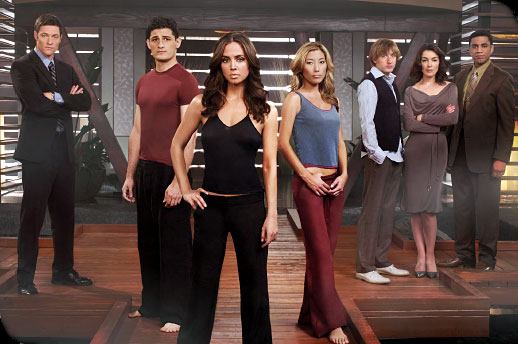
The idea for Dollhouse apparently came about during a lunch Whedon had with Eliza Dushku, when they discussed possible ideas for a vehicle for her. The premise, at least in the week-to-week sense, is fairly simple. The dollhouse is a secret worldwide organisation which brainwashes beautiful young people into "Actives", and hires them out to wealthy clients, having programmed them to be whatever the clients want. When they return, they are wiped clean and spend their days in a child-like, memory-free state while they wait for their next assignment. The Los Angeles dollhouse is run by glamorous Brit Adelle DeWitt (Olivia Williams), with staff including amoral genius Topher Brink (twitchy and funny Fran Kranz), short-tempered security chief Laurence Dominic (Reed Diamond), scarred and sympathetic Dr. Claire Saunders (Amy Acker), and tough-but-gentle handler Boyd Langton (an excellent Harry Lennix. Apart from the fact that FBI agent Paul Ballard (over-earnest Tahmoh Penikett) persists in searching for them, everything is running smoothly. If one of the dolls malfunctions, they're sent to the attic. But one of the dolls, Echo (Dushku), starts to remember her assignments and retains the skills she is given.
This being a Joss Whedon show, there's a big bad company that will bring about the end of the world, the very different characters end up banding together to form a makeshift family, and the dialogue is often excellent. When Dollhouse picks up speed, it's snappy, gripping television. But when Dollhouse was bad, it was infuriating. So what's wrong with it? Well, it got off to a bad start. We were told by the makers that Dollhouse episode 1 would not be the pilot, instead it would be a "mission of the week" installment which aired amid a howl of anguish from the wronged Whedonites. And while we got some nice insight into the workings of the Dollhouse (a theme that would continue to be very strong), the story, about Echo being programmed to be a hostage negotiator, was frankly dull. Echo's plotline was not interesting, and it was the A plot. Episode 2 introduced the big bad Alpha, but kept him offscreen while giving us a Most Dangerous Game storyline in which Dushku was chased around a national park by Matt Keeslar. Nothing we hadn't seen before. The next episode would prove to be the show's worst hour: Echo is programmed to be a backup singer/bodyguard for a pop diva whose stalker may turn deadly. It's one of the worst things Whedon has ever been associated with. The next two mediocre episodes were frankly a relief. But that's five sub-par episodes in a row. Not how you want a TV show to start, especially one that most people are convinced won't last long.
Then, suddenly, Dollhouse got good. Whedon issued a statement telling fans to wait for episode 6, which he said would finally get the plot going and introduce what he was actually trying to with the show. Sure enough, "Man on the Street" was what we were hoping Dollhouse would be. Clever, with adult themes, and moral ambiguity. This rise in quality continued with "Echoes" and "Needs", which pushed the arc forward. Dollhouse was now a must-see. The last two aired episode, "Briar Rose" and "Omega", finally introduced Alpha, a wonderfully psychotic Alan Tudyk, who showed us just how wrong the dolls can go. The slow build gave way to sudden, shocking violence. While the ending was a little rushed, we were left hoping for a second series.
But nobody thought that Fox would bring Dollhouse back for a second series. Yes, the reviews had gone from indifferent to enthusiastic, but the viewing figures were still low. It didn't help that Fox decided not to air "Epitaph One", the last episode of the series. The episode was set in the future and we were shown how technology created by Topher led to the apocalypse. Characters were changed, switched around. Topher was a hysterical wreck, and Adelle had become a motherly figure to him and the others who had barricaded themselves inside the dollhouse against the outside world. in an episode that was both scary and fun in a postapocalyptic way. It was geniunely exciting, it gave us clues as to the final end of the show, and we had to wait for the DVD to get it. But then Fox announced that Dollhouse would be coming back for another thirteen episodes, and we got all excited again.
We hoped that Dollhouse had got over the troughs in quality that the first series had suffered from, but we were wrong. The start of the second series was very much a mixed bag. Amy Acker, so good as the scarred Dr. Saunders in the first series, was no longer a regular. For every good episode (Belle Chose and Belonging were superb), there was an Instinct. Good guest stars (Keith Carradine, Ray Wise, Summer Glau) couldn't help make episodes like The Public Eye much more interesting. As Christmas approached, Fox announced that they would be airing two episodes back to back two weeks running. Then they announced that Dollhouse would not be coming back for a third series.
And just like that, Dollhouse kicked back into gear. The pace was, necessarily, tightened, as the overlong government conspiracy plotlines were condensed to make room for as much character and plot development as possible in the time available. Topher develops a moral compass! Whose side is Adelle on? And what's in the attic? The last six episodes were fantastic.
Perhaps most importantly, Whedon had time to wrap up the series. Unlike his other shows, he has said he has no intention of a comic book spinoff, or any attempts to revive it. Dollhouse is finished, and it finished well. But maybe the overwhelming feeling about Dollhouse is disappointment and a sense of a missed opportunity. It got two series, one more than Firefly. It was given time to tie up most of the loose ends. And, with Epitaph Two, it had two episodes set in the future, meaning that both present and future plot-lines were resolved, which is pretty cool.
So what was the best part of Dollhouse? No, not Echo. Frankly, I found Dushku, her missions of the week, and her relationship with Ballard pretty tedious. Strange that the apparent main plot-line of the series was the least interesting. No, the best part was the dollhouse itself. The really interesting arc was never Echo's, with her struggle to bring the dollhouse down with her accumulated memories. No, the best was the power struggle between the LA dollhouse staff and their employers, the evil Rossum corporation. The dollhouse itself had so many interesting areas that were underexplored. That said, at least we finally got to see the attic
The best characters were the ones within the system. Olivia Williams was superb as Adelle DeWitt, consistently keeping us guessing as to who exactly she was playing for and showing impressive comic timing to go with icy mercilessness. Fran Kranz was a revelation as Topher, who slowly begins to realise that his actions will cause the apocalypse and discovers that he does care. Also impressive finds were Dichen Lachman and Enver Gjokaj as dolls Sierra and Victor. Both manage to do more with their different personalities than Dushku in much less screentime, and get two of the best episodes dedicated to their burgeoning romance. Oh, and Gjokaj does an excellent impression of Fran Kranz. Amy Acker was also great, despite being only an occasional presence, but makes the most of her screentime. Another Angel alum, Alexis Denisof, fares worse in a tedious run of episodes as Senator Perrin who is trying to expose the Rossum corporation, although Summer Glau was a very welcome guest star as Topher's opposite number in Washington, Bennett Halverson.
This is somewhat rambling, but it's difficult to sum up how I feel about Dollhouse' cancellation. In a way it's good that it got wrapped up. It sounds cruel, but when they were under pressure the writing seemed to be so much better. But then again, the show had so much potential. I'm going to miss tuning in to watch Adelle's scheming, Topher's panicked ideas, Gjokaj's hilarious performances when being inhabited by Topher. When Dollhouse was good, it ranked with Whedon's best work. But it was too inconsistent. At least it went out with a bang. And how do you know that you care about a television show? When characters are hurt or killed, and it upsets you. Nobody does that like Whedon, and hey, I cared about these characters.
Best Whedon moment: Subliminal messaging. "There are three flowers in a vase...the third flower is green". That, and the invention of the word "thoughtpocalypse"
Best character: It's a tie between Adelle and Topher. Both Williams and Kranz got the biggest emotional arcs of the characters. For the most part Williams did icy menace while Kranz did comic relief, but check out "Echoes", in which their characters are reduced to a childlike state. Topher: "What's brown sauce made of? Science doesn't know!" Adelle: "It's made of brown!" Topher: "Brown...mined from the earth by the hard scrabble miners of North Brownderton!" Adelle: "My god...I find lentils completely incomprehensible!"
Best violent shock: Tough call, but right now I'm going with the flashback where we see Alpha flip out and first leave his signature on his victim's face. "Let Echo be number one"
Best episode: Damn tricky. I'm going with Needs. Or Spy in the House of Love. Or The Attic. Or Epitaph One. Or Getting Closer, and The Hollow Men...............
Worst episode: Stage Fright. No contest.
One line to sum it all up: "You don't know me! That's the contract. You don't know me, and I don't know you, not fully, not ever! I made you a question. I made you fight for your beliefs. I didn't make you hate me. You chose to."
As Jonny has pointed out so well in his rather fabulous article, we said goodbye to yet another Joss Whedon show. Instead of grieving, we should celebrate! And how do we celebrate best? With lists! So here are my top five TV shows cancelled before their time.
5) Star Trek (1966-9) What with the mass success in spin-off series, motion pictures, t-shirts, video games, action figures and fake languages, it's easy to forget that the originally series of Star Trek was axed after only three seasons. It had to pilot twice for Christ's sake! It has to be said however, I'm not a huge fan of TOS; it hasn't dated terribly well, the episodes are usually over-long and still underdeveloped, however, it does has a wonderful energy about it that some of its successors don't. Where as some later sci-fi shows took themselves a bit too seriously, I don't think that comment can ever be aim at the original Star Trek. Also, I don't think we'll a show do so well out of being cancelled. Even Friends couldn't get a spin-off to work, Star Trek has four (official ones at least - we'll never be able to count the fan made features).
4) Clerks: The Animated Series (2000)
My bizarre up-down relationship with Kevin Smith continues! Back in the days when Mr Smith could do no wrong in my eyes (1994-2004), ABC played two episodes of Clerks: TAS before cancelling it. This would make sense if the, for lack of a better word, colourful language of the feature film was brought to life in glorious cartoon form, but it wasn't. Instead, the show plays like a mash-up of Kim Possible and other later Disney TV series, combined with the, albeit tamed, familiar humour from the View Askew films. In fact, the extent to which this show is child-friend almost adds to the surrealness. There is no swearing, no adult situations, even New Jersey's favourite dope dealers, Jay & Silent Bob don't peddle drugs but rather illegal fireworks. Six episodes is really not enough, especially when considering that everyone seems on the top of their game here - the animation is top notch, Smith's writing has rarely been better or more satirical (although that may have something to do with the inclusion of ex-Seinfeld scribe David Mandel) and the voice cast hit all the right notes. The show makes me nostalgic for things that could have been. Had Jeff Anderson and Kevin Smith not had a huge falling out after Clerks, imagine what else they could have done together! Anderson's deft comic ability is just incredible, had they not fallen out, this man could have been Jason Lee. Think about it. Also, look out for Alec Baldwin's turn as the Clerks' nemesis, Leonardo Leonardo.
3) Arrested Development (2003-6) Okay, I'm sure Jonny's going to put this down as well, but screw him! I'm my own man and I'll put it down if I want to! *ahem* The fact is that I don't believe there has ever been a more talented ensemble cast for a comedic television show. Even further than that, there have been few shows as sharply and consistently written then Arrested Development. Its ability to be simultaneously topical and irrelevant is something to be in awe of, but more impressive is the very subtle foreshadowing of major plot points, ultimately making each repeat viewing surprisingly fresh. It may have launched the one-role career of Michael Cera, but how could I not forgive it? In terms of quality, this should probably be further up my list but, to be honest, after three (well, two and a half) seasons, it feels incredibly well wrapped up. Sure, there are probably more laughs to be had with the Bluth family, but there are other shows out there that deserved more of a chance to shine.
2) My So-Called Life (1994-5) Like this for instance. With all respect to John Hughes, his films never had the emotional resonance with me that they did for many other people. I didn't get through my teenage years with the Breakfast Club or Ferris Bueller. Instead, I had My So-Called Life. I'm not going to pretend that I went to a high school with a gun problem or had friends that were living on the streets, the plot of the episodes are almost a secondary feature. The main event, as it were, is the accurate portrayal of teenage emotions. Like Angela Chase, I grew up in a really stable household and also like her, I sometimes wanted to find faults with it - what teenager doesn't? But having revisited the show since those heady days, what really sticks out is how trivial really everything is. Listening to Angela, her biggest problems are on the whole silly in retrospect but, like many of my teenage problems, seemed so important at the time. After one season, I'd just fallen in love with all the characters (even Brian), but there was no conclusion to the story, no closure. Ironically, it may even be better that way, but one more visit to Chase's house should have happened.
1) Twin Peaks (1990-1) What can I say that hasn't all ready been said, spun backwards, phonetically recited and then spun backwards again. All I'm going to say is that this show was heading to an explosive third season: How much damage will Bob do? Will the town folk stop him? Will Agent Cooper ever be free? What could have been a great good versus evil showdown never happened - even the feature film spin off looked backwards. Oh Diane, will we never see those wonderful trees again? Take it away, Man from Another Place.

 Killer Instinct, the first of the two, is probably the better film. It moves so quickly that pretty much the only way to keep track of the passing of time is how many children Mesrine has with his first wife, Sofia. Heists, murders, wives, accomplices all pass by with lightning quick. Cassel's standout performance is backed superbly by an on-form Depardieu as Mesrine's first boss Guido, Gilles Lelouche as his old buddy who gets him into the gangster life, Elena Anaya as his suffering first wife and mother of children, and Cécile de France as his soul-mate second wife who joins him on his life of crime, Jeanette Schneider.
 Things slow down considerably with Public Enemy No.1, although it starts with a lightning quick daring escape, as Mesrine manages to flee his own trial. The second film also suffers a little from overfamiliarity. There's another moll (Ludivine Sagnier), another prison break with another accomplice (Mathieu Almaric). There's nothing wrong with any of these things, but we know where it's going. Sagnier is a nice counterbalance to the aging Mesrine, an excitable girl who's won over by the money and fun, and Almaric does twitchy nervousness very well.
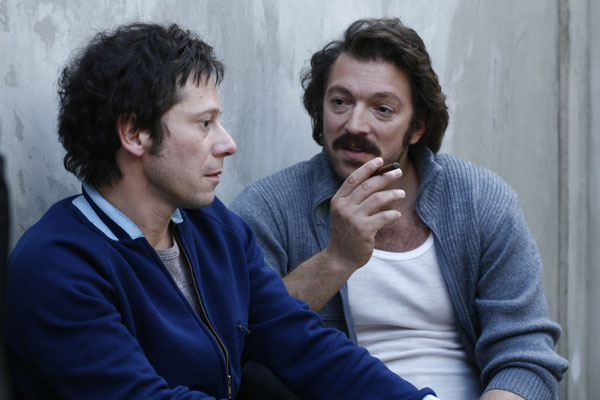 Both films are very well-written, and fantastically shot. I was only familiar with Richet's better-than-it-should-have-been remake of Assault on Precinct 13, but his spontaneous style works fantastically. Mesrine also goes straight onto the short list of films that actually use split screen very well, as it gels naturally with the overall feel of the two films.