Tuesday, 30 March 2010

TV Guide: Part One

It's about ten years since we started to realise that it was fine to admit that we watched TV. Shows like The Sopranos, Six Feet Under, and 24 changed our expectations of what a television series could accomplish. Since then, several television networks have been striving to create their own must-see programmes and conquer the monopoly that HBO had, and still has to some extent. It used to be that only HBO had shows filled with sex, violence and foul language (Seemingly the holy trinity of the "It's not TV. It's HBO" ethos.). Now, networks like Showtime and FX are pushing boundaries. It's not just the quality of the shows themselves either. Advertising for televisions series has become more and more eye-catching, putting lackluster movie posters to shame.
We're going to be looking at several television series in detail, and talk about what they represent for the medium and how they compare to similar films. But to start with, we're going to look at each network and what they have to offer, and how they compare to each other

ABC
Sex, Violence, Swearing?: No. ABC is family friendly. Even the more adult-themed shows feature no cussing. Of course, after the watershed there will be a bit of violence but nothing HBO-worthy
Past programmes: ABC is one of the big networks, airing comedy, drama and sci-fi since the 1960s. Their impressive roster includes Twin Peaks, Alias, Ellen, Happy Days, Sports Night, Spin City, Pushing Daisies, Boston Legal, Kingdom Hospital, The Middleman, and the original Battlestar Galactica. This barely touches on the golden oldies like Charlie's Angels and The Addams Family. But how are they doing now?
On the air: Definitely skewed towards the mainstream. On the decent end of the scale we have Nathan Fillion-starring crime drama Castle, and family dramedy Brothers and Sisters. They're also responsible for some of the biggest shows on TV. JJ Abrams' Lost, Grey's Anatomy, Desperate Housewives, the V remake, Ugly Betty, and Flashforward. But Lost, Grey's, Housewives, and Ugly Betty are all coming to an end. Flashforward and V were huge investments but have been critically scorned. Comedy-wise, ABC have Scrubs' creator Bill Lawrence's Cougar Town, starring Courtney Cox, and Modern Family
Upcoming: There's some promising darkness with Happy Town, in which a small town has it's first crime for months after a series of kidnappings, starring Sam Neill, Stephen Weber, and Amy Acker. Also coming soon is Copper, a less-starry, more generic sounding drama.
Must see TV?: Hmmm...Castle is good, silly fun, but it relies heavily on the chemistry between Nathan Fillion and Stana Katic. Otherwise we're really just waiting for Happy Town.


AMC
Sex, violence, swearing?: Yes, indeed. While Mad Men is pretty restrained, owing to its period setting, Breaking Bad is very much an adult show.
Past programmes: Not much. AMC seems to have only started making their own shows fairly recently
On the air: Ah, here is where it gets interesting. In 2007 AMC aired Mad Men, the 1950s set drama about ad men in New York. Now gearing up for it's fourth series, Mad Men drew critical acclaim and has entered into pop culture thanks to it's style and superb cast. In particular, it has catapulted blog favourite Jon Hamm onto the A-List.
AMC followed Mad Men with Breaking Bad in 2008. Now on its third series, Breaking Bad quickly drew similar levels of adoration as Mad Men, albeit at a slower pace. Starring Bryan Cranston (The dad from Malcolm in the Middle and sleazy dentist Tim Whately on Seinfeld) as a high school chemistry teacher Walter White, who starts cooking crystal meth when he discovers he has cancer, it's edgy, violent, and utterly compelling. It's also given Mad Men a run for its money in the awards stakes.
The network also made the surprisingly decent mini-series reworking of The Prisoner, staring Jim Caviezel and Ian McKellen. There were rumours about expanding it to a full series, but at the moment it doesn't look likely
Upcoming: AMC have committed to a full series for Frank Darabont's adaptation of popular graphic novel series The Walking Dead. This shows an impressive level of confidence, and, if it works, could well lead the way for more TV versions of comic books.
Must see TV?: Yes. Mad Men and Breaking Bad are two of the best shows around.

Fox
Sex, violence and swearing: No, it's not a cable company. The big hitters go by network guidelines.
Past programmes: Cancelled cult favourite Arrested Development, Malcolm in the Middle, That 70s Show, cancelled cult favourite The Tick, The Tracey Ullman Show, Judd Apatow's cancelled cult favourite Undeclared, our favourite cancelled cult favourite cartoon Futurama, King of the Hill, Ally McBeal, cancelled Nathan Fillion-starrer Drive, The OC, Prison Break, cancelled cult favourite Wonderfalls, cancelled cult favourite Dollhouse, The X-Files, Millennium, prematurely cancelled Terminator: The Sarah Connor Chronicles, and, perhaps most importantly, cancelled cult favourite Firefly. If you think you see a pattern here, well done. There's a reason that Fox have earned the hatred of nerds everywhere. They commission great series, then cancel them. They also own the rights to Buffy the Vampire Slayer and Angel, both of which were originally broadcast on The WB.
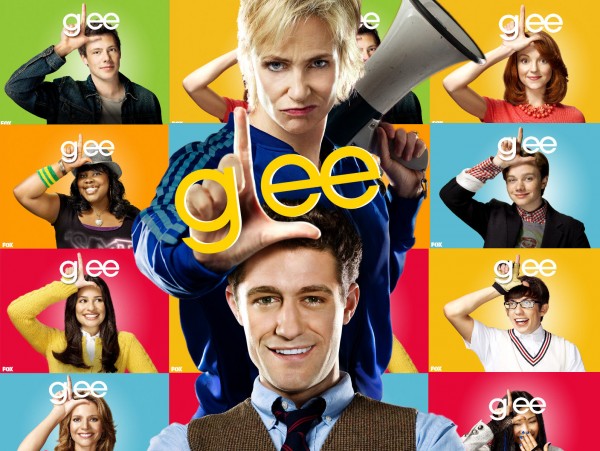
Currently airing: Keifer Sutherland-starring 24, which is finally coming to an end, solid hits such as House, Lie to Me, and Bones, JJ Abrams' erratically excellent sci-fi Fringe, and this year's monster success Glee. They're also still the big animation network, with The Simpsons, Family Guy, and American Dad.
Upcoming: Not much. Maybe people are finally starting to realise that Fox isn't the safest place to be. We don't understand why they would invest so much in shows that show so much promise, then shut them down before they have a chance to get going.
Must see TV?: It would be foolish to write off Fox, and chances are you're probably already watching Glee. They've shown they're very good at capturing zeitgest shows, such as The X-Files, 24, The OC, Prison Break (so good in season 1, so bad afterwards), and House. But the best shows they have are currently on FX


FX
Past programmes: Not much of interest. FX has been around for a while as a spin-off of Fox, but has only recently been producing adult-themed, acclaimed shows. The first big one was The Shield, followed by the just-finished Nip/Tuck. Also no longer running are Courtney Cox tabloid drama Dirt, Andre Braugher-starring Thief, and Eddie Izzard/Minnie Driver con-men show The Riches.
Currently airing: Denis Leary's controversial firefighter drama Rescue Me has proved consistently popular and is going into season 6, and acclaimed legal drama Damages, starring Glenn Close, is currently in its third season. The big new things are the excellent biker crime drama Sons of Anarchy, starring Ron Perlman, which has just finished its second season, and just-premiered Justified, based on an Elmore Leonard book and starring Timothy Olyphant as a US Marshal forced to return to his home town. There's also the fantasy football comedy The League, and offbeat animated comedy Archer.
Upcoming: Not much at the moment, with Justified only very recently having started. Sons of Anarchy, The League, and Archer have all been given another season.
Must see TV?: Yes. Sons of Anarchy is very good, uncompromising television. Justified has a lot of hype and pedigree. However, Rescue Me went off the boil a while ago, and Damages is starting to get some iffy reviews.


Well that's it for part one. See you soon for part 2, where we'll look at NBC, HBO, and Showtime!

Sunday, 28 March 2010

Recent Release Reviewed: The Girl With The Dragon Tattoo


The Girl With the Dragon Tattoo
Starring: Noomi Rapace, Michael Nyqvist, Lena Endre, Peter Haber, Sven-Bertil Taube
Screenplay: Nikolaj Arcel, Rasmus Heisterberg, based on the novel by Stieg Larsson
Director: Niels Arden Oplev

Disgraced journalist Mikael Blomkvist (Nyqvist) is contacted by old, incredibly wealthy industry tycoon Henrik Vanger (Taube). Henrik wants to find out what happened to his beloved niece Harriet, who disappeared 40 years ago, and has narrowed down the suspects to the members his family, many of whom have ties to Nazi groups. As Blomkvist relocates to the small village of Hedeby, where the Vangers live in wealthy isolation, troubled computer hacker and loner Lisbeth Salander (Rapace) gets wind of the investigation and decides to get involved.

The first of three Swedish films based on the incredibly popular Millennium trilogy gets things off to a very good start. The tragic story of Stieg Larsson, who died before the publication of the books, is movie-material itself, but The Girl With the Dragon Tattoo crams enough intrigue, murder, and violence to fill its two-and-a-half hour running time.

Almost inevitably, the fact that the film is in a foreign language has placed it in the arthouse arena. While it is beautifully shot and determined to go at its own pace, it's also very much a dark, violent, thriller reminiscent of Se7en and The Silence of the Lambs. It's a murder mystery based around a rich reclusive family, the main character is a journalist, there are red herrings and sudden shocking violence. The comparison to these 1990s genre films isn't supposed to be detrimental. In fact, The Girl with the Dragon Tattoo is probably as close as any film's come to that quality since.

Aside from its inherent Swedish-ness (Yes, that's a thing), three things really set this film apart from the many, many other films crowding the genre. The treatment of misogyny and violence against women, the two leading actors, and the character of Lisbeth Salander. The Swedish title translates as Men Who Hate Women, and that is accurate, to put it lightly. Of course, we know that victims of serial killers are traditionally women, but the film is uncommonly unflinching in it's depiction of the violence. These scenes are graphic, brutal and hard to watch. This ties in closely with Lisbeth Salander, who is clearly, by quite some way, the best thing that the film, and the book, has going for it. Excellently played by Noomi Rapace, Salander is a tattoed, pierced, Goth loner who has been abused by the system which has kept control of her since events in her youth. As the film starts she is placed under the care of a new guardian who clearly falls into the title's category. Lisbeth fights back, and keeps fighting throughout the whole of the film.

Rapace gives a very deft peformance. Tough yet vulnerable, she also shows a keen grasp of light comedy in her scenes with Michael Nyqvist, who also does excellent work in the role of Blomqvist. A Hollywood remake would presumably soften Lisbeth's rough edges, and either make Blomqvist about ten or fifteen years younger, or cast someone more conventionally attractive than Nyqvist, who resembles a slightly rounder Mathieu Almaric. Both actors deserve the attention they've been getting. The rest of the cast give very good performances, and special mention must go to Peter Andersson as Lisbeth's repulsive guardian.

Director Niels Arden Oplev does very well creating the oppressive atmosphere of the Vanger family compound, and he and the writers should be commended for the work they did compressing the novel, which was occasionally guilty of padding, into a film that, although perhaps a little long, suffers from few dead patches. Oplev has made a gripping, tense thriller that deserves an audience beyond the arthouse.

7.5/10

Friday, 26 March 2010

Forthcoming Film Furore!: Scott Pilgrim and MacGruber


Yesterday the first official teaser trailer for Edgar Wright's Scott Pilgrim Versus The World hit the interweb, with fans everywhere going crazy. The film marks Wright's first film without his Simon Pegg/Nick Frost support structure, not to mention his first film set in the US. Based on the popular comic book series, Scott Pilgrim is the story of the titular character's attempts to defeat his new girlfriend's seven evil exes. Realism is not the order of the day, with overblown actions sequences sure to abound.
The supporting cast is impressive: Brandon Routh (Superman Returns), Chris Evans (Sunshine), Mae Whitman (Arrested Development), and Jason Schwartzman are among the exes, Up in the Air's Anna Kendrick plays Scott's sister, and Mary Elizabeth Winstead (Death Proof) plays Ramona Flowers, the object of Scott's affections.
But our two major concerns lie with the tone and the star. Knowing silliness is all very well, as long it's entertaining. If the film starts to get snarky, the goofy appeal with surely fly out of the window. And have we had enough of Michael Cera? OK, so the part does seem to fit him like a glove, but hasn't every part he's played since Superbad?
Obviously, I'm being unfair as this is just the teaser trailer. But, this is, just, like, our opinion, man.


Next up is the moderately funny trailer for Saturday Night Live-spinoff movie MacGruber. The sketches were often hilarious, featuring Will Forte as an inept MacGuyver character who was constantly distracted from defusing the bomb by issues such as Pepsi sponsorship, his son's sexual orientation, and accusations of racism. But there hasn't been a good film based on an SNL sketch for a long time. Can MacGruber hold up to a feature length treatment?
Well, the trailer is OK. Forte seems to be on form, there's the impressive casting decisions (Val Kilmer as a villain called Dieter Von Cunth, Powers Boothe as MacGruber's boss, Ryan Phillipe), a couple of the jokes hit the mark, and it has the fantastic Kristin Wiig. But to be honest, it's not particularly inspiring.
That being said, every review of the film that's come out of the festival circuit has been overwhelmingly positive. Word is that the funniest scenes are definitely not in the trailer, the film is very much R-rated, and it's hilarious. It'll be interesting to see how the film fares on wide release, but we're looking forward to it.

Thursday, 25 March 2010

Recent Release Reviewed: 44 Inch Chest


44 Inch Chest
Starring: Ray Winstone, Ian McShane, John Hurt, Tom Wilkinson, Stephen Dillane, Joanne Whalley
Screenplay: Louis Mellis, David Scinto
Director: Malcolm Venville

"You're in the right, Colin. Remember that."

Colin Diamond (Winstone) is a broken man. His wife Liz (Whalley) has left him. Lying on the floor of his house surrounded by the debris of his rage, listening to Harry Nillson's "Without You", he picks up the phone and calls Archie (Wilkinson). Archie calls Meredith (McShane). The next day the three of them, accompanied by Mal (Dillane) and Old Man Peanut (Hurt) kidnap a French waiter from a restaurant and take him to a run down old house. There they wait for Colin to kill "Loverboy", drinking, smoking, and taunting the poor man who's locked in the cupboard, but Colin's not the man he used to be.

Expectations were pretty high for this Brit flick, and reasonably so. From the writers of Sexy Beast and featuring a cast full of some of the best actors around. I thought that 44 Inch Chest would be a cult hit, receive lots of good reviews and maybe even be one of the sleeper hits of the year. But then it got a fairly muted reception at the festivals. Comparisons to Sexy Beast were unfavourable. The only thing people seemed to be positive about were the performances and the swearing.

Well, these two aspects of the film are certainly the strongest. The dialogue seems tailor-made for each of the incredibly talented actors who comprise the cast, and they tear into it with vigour. Winstone is an actor who always seems to be happiest when not being pressured to put on an accent and 44 Inch Chest finds him well within his comfort zone, vocally at least. But this also his best performance since Nil by Mouth. He's normally called upon to be threatening and intimidating, which he can do with his eyes closed. Here, he's shivering and shaking. He's backed up by a cast who are all clearly thoroughly enjoying themselves. McShane gets to show a bit of range as the urbane, homosexual Meredith, who seems to be the most balanced of Colin's band, but no less deadly for it. Wilkinson is well-cast as mother's boy Archie, and Dillane gives a strong performance as the acerbic Mal. Perhaps most impressively, he manages to not remind us that Tim Roth was originally cast in his part before having to bow out due to his commitment to US show Lie to Me. And then there's John Hurt. Hurt's played bastards before, but never one quite so foul-mouthed and brimming with bile as Old Man Peanut. With hair pressed flat back against his skull and a set of false teeth, given one-liners like "I wouldn't give her the pickings out of my handkerchief!", Hurt apparently decided to chew up the scenery with fantastically malicious energy.

Energy is what the film needs. At its core, the un-cinematic plot of 44 Inch Chest could easily be a play. It's set almost entirely in one room, and when the film leaves the room, it loses the plot. So, for the first half, the film relies entirely on the cast and the dialogue. No room for flashy camera tricks in the room. This is not necessarily a bad thing. If you're going to watch a group of actors sitting around talking, you could do much worse than be saddled with this cast. But it's also clear that director Venville, and writers Mellis and Scinto, are self-conscious about the one-location issue, and take every opportunity to escape.

Instead of giving us any time with the characters prior to the kidnapping, the filmmakers instead give one flashback to Meredith, one to Colin, and make the reckless choice of placing the entire second half of the film in Colin's head. Let's deal with the flashbacks first. Colin's shows us just how he found out that Liz was cheating on him: she told him. It's well-shot, showcases Winstone and Whalley well, and gives us vital information about the characters. Meredith's flashback is entertaining but has no relevance to the plot. Telling us about how he accompanied eccentric Tippi (an OTT Stephen Berkoff) to a casino and made thousands of pounds gambling, it seems to exist purely to allow McShane to look at the camera and have Berkoff ham it up.

Then there's the second half. After about 45 minutes of build-up, Colin orders his friends out of the room so he can have a one-on-one chat with Loverboy. No problem here, but we suddenly find ourselves in Colin's tortured mind. The dialogue's still fun but lacks the immediacy and rawness of the first half since we know that it's not real. And frankly the less said about the country estate fantasies the better. I'm not complaining about the lack of violence in the film, although I can imagine that audience members anticipating a Brit gangster flick will be let down. There is violence here, but it falls into the "abuse" category rather than "cool stylized". It's also important to mention that Whalley's performance in the second half of the film, as the seductive man-eater vision of Liz that Colin has in his head, is excellent. But the second half is definitely where the film goes off the rails. I don't like to criticise a film for trying to reach beyond it's genre limitations but the majority of the dream sequences are pretentious mistakes.

It's a shame because 44 Inch Chest has plenty of redeeming features. Colin Diamond is a fascinating character, convinced he's hurting because he loves too deeply and mostly blind to the fact that he's actually a monster. The pleasure of watching the cast enjoy the dialogue is something that is difficult to overstate. There's also a nice score from David Lynch regular Angelo Badalamenti and Massive Attack. Is it worth a watch? Certainly. Winstone, Hurt, and McShane are at their best and that's not something to ignore. There's the bizarrely fantastic sequence in which Old Man Peanut narrates Samson and Delilah ("What's her name? Delilah. Yeah....right hooer!") And when 44 Inch Chest is running smoothly, it's as good as we hoped. It's just can't keep up with it's pretensions.

6/10

Wednesday, 24 March 2010

Top 10 Steven Moffat moments in Doctor Who


As I'm sure you're aware, the new series of Doctor Who airs in just under two weeks time. While I am not oblivious to the fact that many will be mourning the departure of head honcho Russell T. Davies and, more probably, Doctor David Tennant, this new series has me all excited. A fresh-ish start, a new doctor in the form of Matt Smith, a new companion in Karen Gillan, playing Amy Pond. More importantly, this new series will be running under the stewardship of Steven Moffat, the man behind some of the best episodes of Doctor Who since it's relaunch: The Empty Child, The Doctor Dances, The Girl in The Fireplace, Blink, Silence in the Library, and The Forest of the Dead. Here are our favourite slices of Moffat-y goodness:


1. "Are you my mummy?"
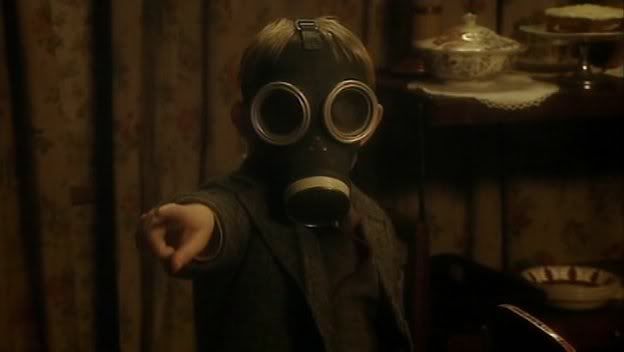
The Empty Child and The Doctor Dances. The two-parter set in London during the Blitz, as very, very creepy child wearing a gasmask wanders the night looking for its mother. We don't find out what it is until the end of the second part, but we know that it's persistent and dangerous. Did we mention how creepy it is? Moffat also makes great use of Christopher Ecclestone's Doctor, who shows curiosity and bravery while most of us would be running for the door. As an aside, while this list is for Moffat, these episodes remind us what a shame it is that Ecclestone decided to only make one series.

2. The Tardis phone rings
"Don't answer it. It's not for you"
"And how do you know that?"
"Cos I do. And I'm telling you. Don't answer it."
"Well, if you know so much, tell me this. How can it be ringing? It's not even a real phone, it's not connected."
This is a simple little trick, but it works. We know that the Tardis phone can't ring. So how does it feel when it does? Scary.

3. Richard Wilson as Dr. Constantine
Ah, the time honoured tradition of getting a recognisable, respected elderly actor to deliver exposition. As the doctor discovers the abandoned hospital full of corpses wearing gasmasks, Victor Meldrew himself appears, on his last legs, to warn the Doctor. "Don't touch the flesh." The Doctor begins to realise that each patient has the same injuries. "Physical injuries as plague." We also get one of the biggest shocks of the series as the Doctor tries to guess the cause of death. "There wasn't one. They're not dead", Constantine tells him, and knocks over a bin, prompting all of the bodies to sit up. He also gets the first transformation that we see, as he succumbs to the virus.


4. What's ticking?
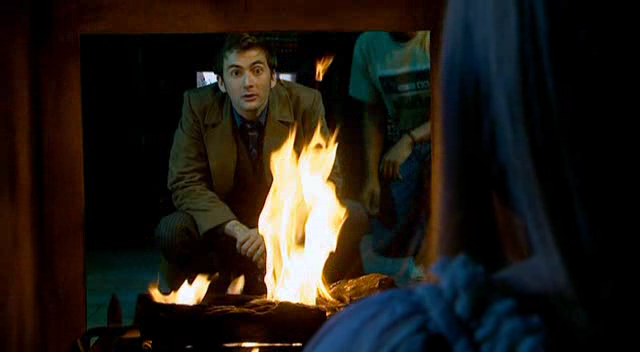
The Girl in the Fireplace sees the Doctor battling robots looking to steal the brain of the Mistress Pompadour. Near the start of the episode, the Doctor finds himself in a young girl's bedroom in 17th Century France. He approaches a clock on the mantlepiece.
"OK that's scary."
"You're scared of a broken clock?"
"Just a bit scared, just a little tiny bit, yeah. Because, you see, if this clock's broken, and it's the only clock in the room, then what's that....Because, you see that's not a clock. You can hear that in the resonance, too big. Six feet, I'd say. Size of a man..."
Also, there are few things more scary than being told by the man who's just founds something under your bed "Don't look round."

5. The Doctor and Madame du Pompadour
While a lot of the complaints about the flirtiness of the Doctor with his companions can be justified, the chemistry David Tennant has with Sophia Myles in this episode is undeniable. It came early enough in the show's run for the "sad, lonely Doctor" schtick to still be fresh, and the rapport between the two actors is great. Probably has something to do with the fact that they were a couple at the time.


6. Pretty much all of Blink
OK, how do I choose a favourite bit of Blink? Can't really. It's scary, it's funny, it's possibly the best thing that Moffat has ever written. Carey Mulligan is fantastic as the plucky Sally Sparrow, the lead in this mostly Doctor-free episode. It's got great, funny supporting characters in DI Billy Shipton ("Life is short and you are hot") and the nerdy Larry Nightingale. The Weeping Angels are brilliant villains. And the gimmick, don't blink or they'll get you, is brilliantly simple and terrifying. Just a great episode


7. Stay out of the shadows
Like Blink, Silence in the Library has a simple premise: There's something in the shadows that kills people.
"Almost every species in the universe has an irrational fear of the dark, but they're wrong, because it's not irrational. It's Vashta Nerada"
"What's Vashta Nerada?"
"It's what's in the dark. It's what's always in the dark."
Moffat continues his run of things that scare children, as remind us that we used to be scared of them too: Losing our mother, realising that something's under the bed, and finally: There's something in the dark. It's also, like Blink and The Girl in the Fireplace, got a neat one-liner that sums up the threat. "Don't blink" for Blink, "What's that ticking?" for Fireplace, and "Count the shadows." for Library. Because, as the astronaut archeologists find out, if you get two shadows, you're done for. "Who turned out the lights?"

8. Miss Evangelista
The secretary to Steve Pemberton's pompous archeologist, Miss Evangelista is well-intentioned but very, very stupid. "My dad said I had the IQ of plankton, and I was pleased." All the crew laugh at her, and we do as well. Which makes it a bit of a shock when she dies first. The crew have to listen as she "ghosts" (her consciousness is briefly trapped in her intercom after her death), and tells them that she can't see. She asks for Donna ("The nice woman") and tells her "What I said before. About being stupid. Don't tell the others, they'll only laugh." Moffat's not just about scares, this scene is impressively touching. Of course, Miss Evangelista comes back in part 2, with her beauty and brains swapped.

9. A brief message from the head librarian
The creepy help points with, as Donna points out, a real face, helpfully sets up the episode for The Doctor and Donna in a wonderfully creepy monotone. "There follows a brief message from the head librarian for your urgent attention. It has been edited for tone and content by Thelman Lux automated decency filter. Message follows: Run. For God's sake, run. Nowhere is safe. The library has sealed itself. We can't. Oh. They're here. Arg. Slarg. Snick. Message ends. Please switch off your mobile comm units for the comfort of other readers."
It's a tried and tested trick, the old discovery of a warning that ends with the messenger's death, but there's a reason it's here. Because it's effective.

10. Doctor Moon spills the beans
For most of Silence in the Library, we're trying to understand the connection between the Doctor and Donna's adventures in the library, and the little girl who seems to be undergoing pyschiatric treatment, who is being told that the library is just in her mind. Near the end of part one, the little girl is told that her doctor would like a word. As she sits and her father leaves the room, Doctor Moon tells her:
"This is important. There's the real world, and the world of nightmares. That's right, isn't it, you understand that?"
"Yes I know, Doctor Moon."
"What I want you to remember is this, and I know it's hard. The real world is a lie. And your nightmares are real. The library is real. There are people trapped in there. People who need to be saved. The shadows are moving again. Those people are depending on you. Only you can save them. Only you."

I know I've missed out several things here, including Alex Kingston's fantastic River Song, and strangely it seems to be heavily weighted towards Silence in the Library, but hopefully this has been a nice reminder of why we should all be very excited about the new series of Doctor Who. Personally, I can't wait.

Tuesday, 23 March 2010

Recent Release Reviewed: A Single Man

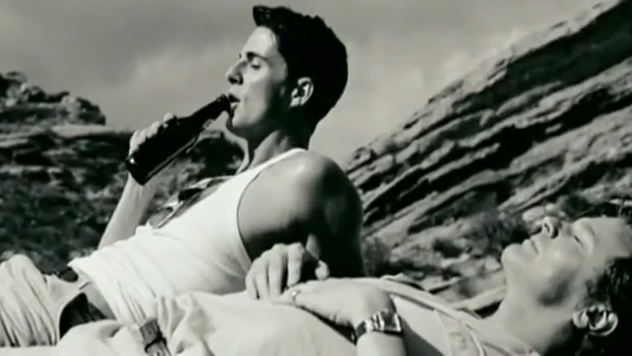
There's a moment about halfway through A Single Man where George Falconer (Colin Firth) discusses his past relationships with his love Jim (Matthew Goode). As he discusses his previous affairs with women, George becomes increasingly flabbergasted about Jim's persistence that he always knew his own sexuality. George then says You know, that was the first thing that I noticed about you was how sure of yourself you were. Although the line represents the beginnings of change in society, it is also analogous to a description of the film's director, Tom Ford.
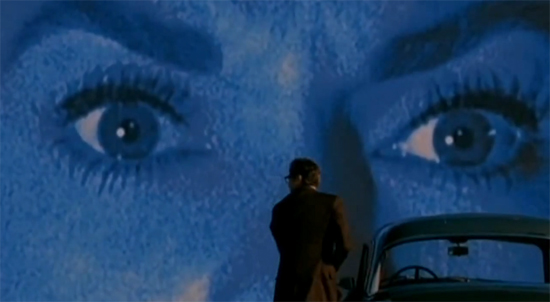
A Single Man, based on the novel of the same name by Christopher Isherwood, is the directorial début of Mr Ford, a man who, until recently, was more famous for his work in designer fashion. Outcries of 'vanity project' were made frequently when the film was announced. If there is one thing this film does well, it is in quashing these declarations. Mr Ford shows himself to be a very competent director as he and his cast recreate the looks of the early 60s in this tragic tale of lost love.

The film revolves around the plight of George Falconer after losing the love of his life, Jim, in a car crash. The narrative occurs eight months after the event. Apart from the odd flashback, the story is contained in one 24 hour period - at the end of which, George plans to commit suicide. Depending on how talky/action-packed you like your films, this already sounds like an intriguing or dull premise. This is not a film containing a lot of twists or plot devices. There are no cliffhanger moments, yet I was riveted throughout its running time. Why? Simply because I have not seen a film with such artistic and visual creativity play in a big business multiplex cinema for an incredibly long time.

First things first, many viewers and critics have focused on, as expected given the director's previous career, the wardrobe and sets of the film. Some have heralded the perfect and pristine nature of the costumes as, although beautiful, someone distracting. There is in fact one scene especially that hammers home this criticism which involves Colin Firth still looking perfectly and pristinely dressed whilst on the toilet. I appreciate this comments, but feel that they are secondary to some of the more serious criticisms against this film. Also, saying Mr Ford does not allow his characters to scruff up their clothes is silly. It just happens that his characters believe it important to be well dressed. My complaints with the wardrobe tie in with my complaints with the direction. Although it is wonderfully creativity, it is at times heavy handed. This is perfectly exemplified by the appearance of rent boy dressed exactly like James Dean. Not similarly, but exactly. He then tells George that people say he looks like James Dean. One or the other, the costume or the line, both is insulting to the audience in a manner similar to James Cameron's Avatar.


It is these sort of problems that plague A Single Man and, at times, threaten to consume it. Mr Ford has a stunning sense of composition, an enviable quality that I wish more directors possessed. Watching this film purely as a visual art is incredible. Within the opening 20 minutes, there are more elaborate and beautiful shots and visual motifs then I am likely to see in mainstream cinema for the remainder of the year. However, unfortunately, despite such a precise and nuanced start, the visual symbolism becomes increasingly heavy handed to an annoying degree. Even tricks that appeared subtle at the start of the film are rehashed, but all the grace is taken out. It is almost as if, at least in regards to cinematography, there were two directors supervising. One example of this is the everchanging temperature of the film. This is a simple trick utilised to display George's inner moods. When he is feeling despaired, the temperature of the film is lowered, which reduces the saturation. In contrast, when he is feeling renewed and human again, the warm tones of the picture return. Like I said, this is a blunt and obvious technique, however, at first, it is performed with the utmost subtlety, in an almost blink-and-miss-it fashion. As the film progresses, this becomes more and more pronounced which left me feeling insulted. I don't know whether Mr Ford was attempting to highlight the exaggerated fractious temperament of George, but if so, there are better and more varied methods to present this. If there is one complement for this technique, it always it utilised with the confidence alluded to in the dialogue of the first paragraph. Mr Ford may be annoying us with the brash handling of this symbolism, but he seems fully in control of the picture.

Despite this, things are not all doom and gloom. Not only does Mr Ford present more visual ideas in one film than Michael Bay is likely to show in his lifetime, but he shows himself as being quite apt in directing actors. This is no doubt helped by the calibre of performers in this film (believe me, Colin Firth deserved the Oscar nomination at the very least). Aside from the sublime lead performance, the three main supporting roles are all filled by three highly talented professionals. Julianne Moore again highlights why she is such a revered actress playing George's ex-lover and long term friend, Charley, a hip but deeply wounded and distressed woman. Likewise Matthew Goode presents possibly the best performance of his film career so far. Hopefully he will continue to work on projects like this - he plays American very well, unfortunately the same cannot be for his Irish and pseudo-Germanic. Even on paper, Nicholas Hoult is the weak link in the leading players, however, looking at the talent on hand, there is no shame in this. Fortunately for him, he presents a fine performance, one that, if rumours are to be believed, may have improved had he had further time to prepare. Giving him the benefit of the doubt, his performance ranges from adequate to good. His earlier scenes are unfortunately a bit flat, however, the intimacy he brings to the final section of the film provides a wonderful contrast to the restrained George.


Final thoughts: A visual tour-de-force for the first 20 minutes, but even though the images falter, the acting is enough to keep one fully entrenched in the quiet story unfolding about one man's grief. I look forward to Mr Ford's follow up feature, whatever it may be.

7/10

Sunday, 21 March 2010

Recent Release Reviewed: Shutter Island

Shutter Island
Starring: Leonardo DiCaprio, Mark Ruffalo, Ben Kingsley, Michelle Williams, Max von Sydow
Screenplay: Laeta Kalogridis, based on the novel by Dennis Lehane
Director: Martin Scorsese

It's 1954, and Federal Marshal Teddy Daniels (Leonardo DiCaprio) and his new partner Chuck Aule (Mark Ruffalo) arrive on Shutter Island, an maximum-security asylum for the criminally insane. They're here because one of the inmates, Rachel Solando (Emily Mortimer), escaped from her locked cell and is nowhere to be found. The doctors, led by Dr. Cawley (Ben Kingsley) and Dr. Naehring (Max von Sydow), are polite but uncooperative. Teddy begins to suspect that Rachel could not have escaped with no one noticing. He's also haunted by nightmares of his dead wife (Michelle Williams), who was killed in a fire started by an arsonist (Elias Koteas) who he believes is an inmate. Teddy and Chuck find themselves drawn into a mystery there may be no way out of.

Right, that's as much of the story as I can give you without wrecking the film! The first, and perhaps most important, thing to say is that Shutter Island is a big, fun, silly throwback to the type of overblown gothic horror that probably would have starred Vincent Price. From the dense fog that opens the film, to the incredible storm that prevents Teddy and Chuck from leaving, to the crypts, the lighthouse, and the maximum security wing that resembles a torture chamber from the middle ages, Scorsese and his team have turned everything up to eleven. The same instructions have been given to the actors, who all stay on just the right side of hammy.

DiCaprio continues his progression into one of the best actors around under Scorsese's guidance. He's got progressively better with each film, and he does well with a challenging role. It's a big performance, to be sure, but it certainly fits with the tone. Ruffalo is quietly solid in the less showy role of Teddy's loyal partner, Kingsley gives his best work for a while as the softly spoken head doctor, and he is very capably backed up by von Sydow, who's clearly enjoying himself. Michelle Williams gives another excellent performance (following Wendy and Lucy and Synecdoche, New York) as Teddy's deceased wife, and is incredibly haunting in fantastically shot dream sequences that are flooded with colour and layered with dread.

It's also a mark of a Scorsese film that the supporting cast is flooded with incredible character actors. Patricia Clarkson, Jackie Earle Haley, John Carrol Lynch, Elias Koteas, and Ted Levine all make a very big impression in their limited screen time, which for most of them is a matter of a couple of minutes.

Dennis Lehane is known to cinema-goers as the author of the novels Mystic River and Gone, Baby, Gone, both of which were successfully turned into films. The first words that come to my mind when thinking about those two movies are "gritty", "depressing", and "realism". None of these words are applicable here. Shutter Island is overblown in the most entertaining sense of the word. The colours palette ranges from inky black darkness to scenes of almost overwhelming light/dark contrast. Michelle Williams' dream sequences, in particular, are shot with a striking mix of yellow and red that, combined with her excellent performance, make these scenes some of the most memorable.

Shutter Island also draws heavily on 1950s anger and suspicion. The red menace of the Communists is present and correct, although I won't go into it too much here. Teddy Daniels and Chuck Aule both served in the Second World War. Daniels was present for the liberation of Dachau, which we see in carefully judged flashbacks that are given the same treatment as his dreams. There are just as visually striking, but they do not feel exploitative. These scenes move the narrative forward. They also give Daniels another point of antagonism, as von Sydow's Doctor Naehring is German.

And as for Mr. Scorsese? Well, the verve and energy that critics enjoyed so much in The Departed is equally as present here, if not more so. I was not a big fan of Gangs of New York, and I thought The Aviator was entertaining, but it feels like he enjoys these B-movie homages so much more. He clearly had a great time crafting this labyrinthine, over the top Gothic horror. There are things in the film that are easy to criticise, and some of the plot twists are signposted too easily, but the most important thing about Shutter Island is this: It's very entertaining. I'm repeating myself, but it's a big, fun B-movie made by a brilliant director and featuring a fantastic cast. What's not to like?

8/10